The Selleck Group | KW City Views Realty
Scott Selleck · Broker Sales Associate · Request an appointment at meet.sellecksellsnj.com
Bergen County Owner Insight
Serving Bergen & Hudson County · SRES®, e-PRO® · Licensed since 1993. Over 500 transactions closed.
Paid Off but Still Paying Property Taxes in Fort Lee, Leonia and Englewood
Why do I still pay property taxes after my mortgage is paid off? Because the tax is on the property, not the loan. Paying off the mortgage closes the escrow account that paid the bill for you. The bill itself stays, and in New Jersey it is due in four quarterly installments, now paid by you directly to the tax collector.
There are three ways to bring that bill closer to your budget: check whether the assessment is fair, file for New Jersey's property tax relief programs before the November 2, 2026 deadline, or change the house.
The Numbers Behind the Bill
Sources: NJ Division of Taxation, 2025 General and Effective Tax Rates and Property Tax Relief Programs pages (read October 13, 2026); Bergen County Board of Taxation, Tax Appeals FAQ (read October 13, 2026).
- Fort Lee 2025 effective tax rate: 1.839%
- Leonia 2025 effective tax rate: 2.199%
- Englewood 2025 effective tax rate: 2.088%
- Deadline to file the 2025 Application for Property Tax Relief (Form PAS-1): November 2, 2026
- Deadline to appeal an assessment to the county tax board: received on or before April 1, or 45 days after your town finishes mailing assessment notices if that is later (May 1 after a town-wide revaluation or reassessment)
Key Takeaways
- New Jersey property taxes are due quarterly on February 1, May 1, August 1 and November 1, per the NJ Division of Local Government Services. Once your escrow account closes, you pay the tax collector directly.
- You appeal the assessment, not the tax rate. In Bergen County, the petition goes to the Bergen County Board of Taxation and must be received on or before April 1, or 45 days after your town finishes mailing assessment notices if that is later (May 1 after a town-wide revaluation or reassessment).
- ANCHOR, Senior Freeze (Property Tax Reimbursement) and Stay NJ share one application, Form PAS-1. The NJ Division of Taxation lists the deadline for the 2025 application as November 2, 2026.
- The Division states that it does not file the PAS-1 automatically for every eligible applicant. Check the program pages to see whether you must file it yourself.
- A move changes the math. Relief programs tie benefits to ownership and residence dates, and a different home nearby or a home in Florida each carries its own tax picture.
Why the Bill Keeps Coming After the Last Mortgage Payment
While you had a mortgage, your lender most likely collected one-twelfth of the yearly tax each month and paid the town for you. When the loan is paid off, the escrow account closes and any balance is refunded under your loan terms. From then on, the bill is yours to pay, quarter by quarter.
Your bill is your assessed value times your town's general tax rate. The effective tax rate, which the NJ Division of Taxation publishes for every municipality, gives a rough sense of the tax as a share of market value. The Division says the effective rate is for comparison and is not used to compute a bill.
Example only, not a quote, an appraisal or a prediction. Each town's 2025 effective rate applied to a sample price. Englewood uses its single-family median sold price for September 13 to October 13, 2026, per NJMLS data pulled by Scott Selleck. Fort Lee and Leonia had 6 and 4 single-family sales in that period, a sample too small for a reliable median, so they use a round $1,000,000 example instead:
- Fort Lee. A $1,000,000 example price at 1.839% is roughly $18,390 a year.
- Leonia. A $1,000,000 example price at 2.199% is roughly $21,990 a year.
- Englewood. The $657,500 median (10 sales) at 2.088% is roughly $13,729 a year.
Note: Effective rates are from the NJ Division of Taxation 2025 rate table. This is a rough planning estimate. Your actual bill is your assessment times the general rate, and the 2026 rate may differ.
Step One: Check Whether Your Assessment Is Fair
You cannot appeal the tax rate, which comes from the town, county and other local budgets. You can appeal the assessment if it does not fairly reflect market value.
The Bergen County Board of Taxation explains the test. Under the formula known as Chapter 123, the board compares your assessment with the true market value it finds at the hearing. The NJ Division of Taxation defines the common level range as plus or minus 15% of the town's average ratio. If your ratio is above that range, the assessment is reduced to the common level. If it falls within the range, nothing changes. If it falls below the common level, the county board says it is obligated to raise the assessment. That last point is why an appeal deserves a careful look first.
The filing rules, per the Division and the county board:
- Deadline. The petition must be filed and received on or before April 1, or 45 days from the date the bulk mailing of assessment notices is completed in your town, whichever is later; May 1 where a municipal-wide revaluation or reassessment has been implemented (N.J.S.A. 54:3-21). Burlington, Gloucester and Monmouth counties follow a different appeal calendar under the same law, and Bergen County does not. If your property is assessed at more than $1,000,000, the law also lets you file directly with the Tax Court of New Jersey instead of the county board (N.J.S.A. 54:3-21).
- Forms. Form A-1 and Form A-1 Comparable Sales, filed with the Bergen County Board of Taxation. Check the board's page for current filing options.
- Evidence. Sales of comparable properties on or near the October 1 assessment date carry the most weight. An appraisal counts as expert evidence only if the appraiser is available to testify at the hearing.
- Hearing. The municipality is the opposing party, and the assessor may testify. If you miss your hearing without written notice of a postponement, the board may dismiss the case.
Our guide on how to appeal your Bergen County property tax assessment covers the steps in more detail. A home valuation can help you see whether the assessment looks out of line before you decide. It is a market opinion, not an appraisal. Talk with a real estate attorney or tax appeal professional before you file.
Step Two: File for State Relief by November 2, 2026
Three state programs run through one form. The NJ Division of Taxation lists November 2, 2026 as the deadline for the 2025 Application for Property Tax Relief, Form PAS-1, which claims ANCHOR, Senior Freeze and Stay NJ benefits together. You can file online through ID.me or on paper.
What the Division lists for the 2025 application, read October 13, 2026:
- ANCHOR. New Jersey homeowners whose main home was subject to property tax, with NJ gross income of $250,000 or less. Condo owners and resident co-op shareholders who paid property tax on the unit count as homeowners.
- Senior Freeze (Property Tax Reimbursement). The program requires an applicant who was 65 or older on December 31, 2025, or who received Social Security or Railroad Retirement disability benefits, and who owned and lived in the home since December 31, 2022 or earlier, per the NJ Division of Taxation. Income limits are $168,268 or less for 2024 and $172,475 or less for 2025.
- Stay NJ. The program requires an applicant who was 65 or older during 2025, who owned and lived in the home for all 12 months of 2025, and whose income was $200,000 or less, per the NJ Division of Taxation.
Note: Income limits and benefit amounts depend on each year's State Budget, per the Division's program pages. Read the full rules before you file.
A few more details from those pages:
- Who must file. The Division filed ANCHOR automatically for most eligible homeowners. The program requires applicants who are 65 or older, or who receive Social Security or Railroad Retirement disability benefits, to file Form PAS-1 themselves, even if they qualify for only one program, per the NJ Division of Taxation.
- Senior Freeze. It reimburses increases in property tax over your base year on your main home. Beginning with tax year 2024, the Division applies the age, disability and three-year residency rules to the application year, not the base year.
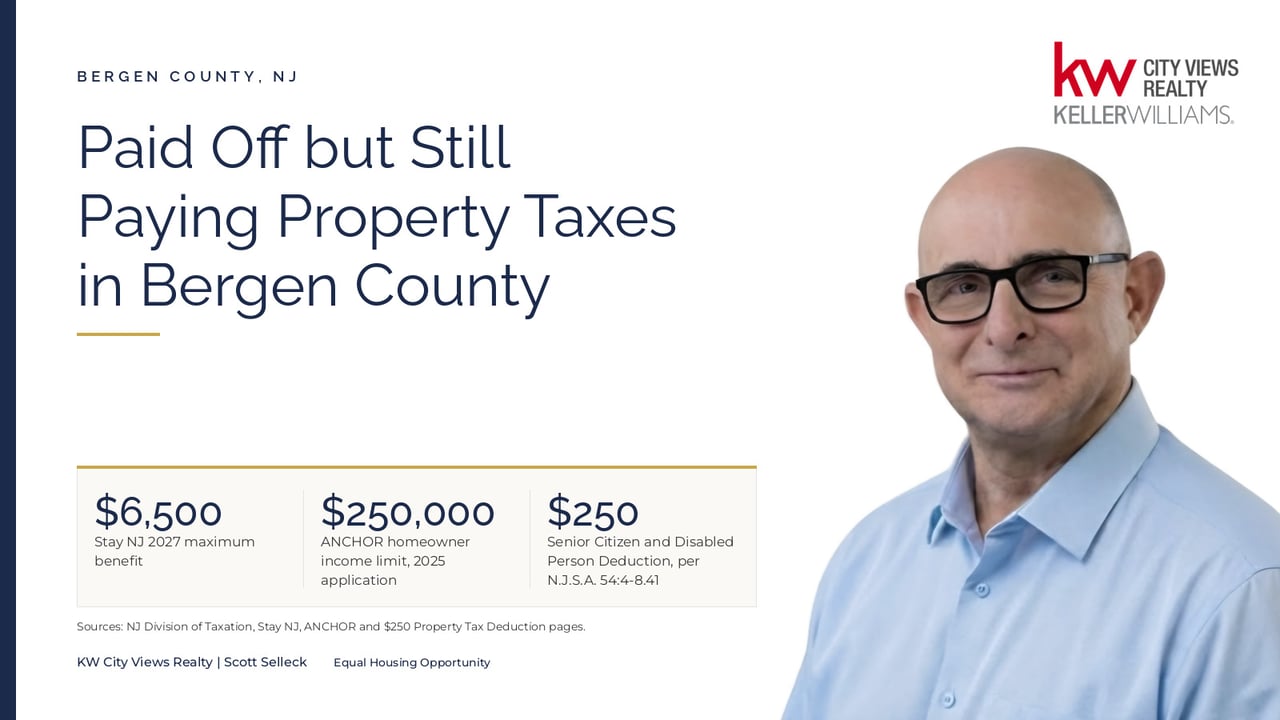
- Stay NJ. The Division lists a 2027 maximum benefit of $6,500 for incomes up to $100,000, $5,000 from $100,000.01 to $150,000, and $4,000 from $150,000.01 to $200,000, on an annualized basis, assuming no changes in the Fiscal Year 2028 budget. It also notes that 2026 payments were split, which lowers the total 2026 benefit.
- The $250 Senior Citizens and Disabled Persons Property Tax Deduction (N.J.S.A. 54:4-8.41). Separately, the $250 deduction requires an owner who is 65 or older or disabled and who meets its residency and income rules, per the NJ Division of Taxation. It is filed on Form PTD with the local assessor or tax collector, and Form PD5 must be filed with the tax collector on or before March 1 each year to keep it.
Check your benefit status, gather your 2024 and 2025 tax bill details and NJ-1040 income figures, and file before November 2.
Step Three: Decide Whether the House Still Fits the Budget
If the bill still does not fit after an assessment check and state relief, the next question is the house itself. There are two local paths and one southbound path.
A different home nearby. From September 13 to October 13, 2026, Fort Lee condos sold at a median of $309,500 on 26 sales and Cliffside Park condos at a median of $570,000 on 16 sales, per NJMLS data pulled by Scott Selleck. Englewood had 4 condo sales and Edgewater had 7, a sample too small for a reliable median. Example only, not a quote or prediction: at Fort Lee's 2025 effective rate of 1.839%, a $309,500 condo implies roughly $5,692 a year in property tax, before monthly maintenance, which varies by building. Condo owners and resident co-op shareholders who pay property tax on the unit count as homeowners for ANCHOR, per the Division.
A move to Florida. Florida has its own property tax, homestead and insurance rules, and the timing of the sale here affects both sides. The Southbound Blueprint lays out the NJ sale and the Florida plan in one document, and I hold a Florida license with Keller Williams Boca Raton Realty. Our post on selling your Bergen County home before your move to Florida covers the order of steps. I am a licensed real estate agent, not a tax advisor or attorney. Confirm residency dates and tax treatment with your CPA before acting on them.
Either way, a sale after many years can raise capital gains questions. Our post on capital gains tax on your Bergen County home sale covers the basics. Before you sell, ask the Division how a 2026 sale or move would affect any relief you have applied for, because each program ties benefits to ownership and residence dates.
I have worked this corridor since I was licensed in 1993, and my verified career record shows over 500 transactions closed. You can read my story for how I came to this work.
The Three Pillars Behind Every Good Decision
Every real estate decision sits where timing, lifestyle, and finances meet. Start with the first and work through all three.
Timing & Strategy
Two dates matter now: November 2, 2026 for the PAS-1 relief application, and, for an assessment appeal next year, April 1, or 45 days after your town finishes mailing assessment notices if that is later (May 1 after a town-wide revaluation or reassessment). Put both on the calendar before you decide anything else.
Lifestyle & Location Fit
Decide whether you want to stay in your home, move to a different home nearby, or plan a move out of state. Each choice changes the tax picture and the relief rules that apply.
Financing & Cash-Flow
Add up the yearly tax, insurance and upkeep on the house you own now, then compare it with the same three lines on the alternative. Confirm the figures with your tax advisor and real estate attorney.
Frequently Asked Questions
Why do I still pay property taxes after my mortgage is paid off?
Because the tax is on the property, not the loan. Your lender paid it from escrow while you had a mortgage. After payoff, you pay the tax collector directly, in quarterly installments due February 1, May 1, August 1 and November 1.
When is the deadline to apply for ANCHOR, Senior Freeze and Stay NJ?
November 2, 2026, for the 2025 application, per the NJ Division of Taxation. All three programs use one form, PAS-1. The Division does not file it automatically for every eligible applicant, so check the program pages to see whether you must file it yourself.
Can I appeal my Bergen County property tax assessment?
Yes. File Form A-1 with the Bergen County Board of Taxation so it is received on or before April 1, or 45 days after your town finishes mailing assessment notices if that is later (May 1 after a town-wide revaluation or reassessment). An appeal can lower, keep or raise the assessment, so check the numbers first.
Does a condo or co-op qualify for ANCHOR?
Yes, if you paid property taxes on the unit. The Division treats condo owners and resident co-op shareholders as homeowners for ANCHOR and says to answer no to the multi-unit question when filing.
Will selling my house affect my property tax relief?
Possibly. Senior Freeze and Stay NJ tie eligibility to how long you have owned and lived in the home. Ask the NJ Division of Taxation before you sell.
What is the $250 deduction?
It is the $250 Senior Citizens and Disabled Persons Property Tax Deduction (N.J.S.A. 54:4-8.41), available each year. The program requires an owner who is 65 or older or disabled and who meets its residency and income rules, per the NJ Division of Taxation. File Form PTD with your local assessor or tax collector, then Form PD5 with the tax collector on or before March 1 each year to keep it.
Want to see what your home and your tax bill add up to before you decide? Start with a home valuation (a market opinion, not an appraisal), take the Seven-Question Assessment (7 questions, about 90 seconds), or Request an appointment and we will run the actual numbers together. If Florida is on the table, start with the Southbound Blueprint linked above.
For more on each town, see the Community Guides and the full library at SelleckSellsNJ.com.
Have a quick question first? Ask my AI assistant on Delphi. It is an AI trained on my material, not a person.
Scott Selleck
Broker Sales Associate | The Selleck Group | KW City Views Realty
Seniors Real Estate Specialist® (SRES®) | e-PRO® | Licensed since 1993. Over 500 transactions closed.
NJ Real Estate Broker Sales Associate License #9236275.
2200 Fletcher Avenue, Suite 502, Fort Lee, NJ 07024
Cell: (201) 970-3960 | Office: (201) 592-8900
Email: [email protected]
Website: SelleckSellsNJ.com
Request an appointment: meet.sellecksellsnj.com
AI assistant: delphi.co/scottselleck
My story: coverstory.sellecksellsnj.com | Verified career record: record.sellecksellsnj.com
Florida
Keller Williams Boca Raton Realty
7280 W Palmetto Park Rd, #110, Boca Raton, FL 33433
Office: (561) 997-0500
FL Real Estate Sales Associate License #SL3588731
I am a licensed real estate agent, not a tax advisor or attorney. Confirm residency dates and tax treatment with your CPA before acting on them.
NJ Real Estate Broker Sales Associate License #9236275. Licensure does not imply endorsement. FL Real Estate Sales Associate License #SL3588731, Keller Williams Boca Raton Realty. Keller Williams City Views Realty and Keller Williams Boca Raton Realty. Each office is independently owned and operated. Broker compensation in New Jersey is fully negotiable and is not set by law or by any board or association of REALTORS®. This article is general information only and is not legal, tax, or financial advice. Confirm your own costs with your real estate attorney, tax advisor, or lender. Equal Housing Opportunity.
Program rules are summarized from the NJ Division of Taxation program pages read October 13, 2026, and can change with the State Budget. Tax figures are examples, not your bill.
Top 5 Sources
- NJ Division of Taxation, Property Tax Relief Programs (ANCHOR, Senior Freeze, Stay NJ; PAS-1 deadline November 2, 2026), with program eligibility pages, read October 13, 2026. Relief programs · ANCHOR eligibility · Senior Freeze eligibility · Stay NJ
- NJ Division of Taxation, $250 Senior Citizens and Disabled Persons Property Tax Deduction (N.J.S.A. 54:4-8.41), read October 13, 2026. nj.gov
- NJ Division of Taxation, Assessment and Appeals, and Bergen County Board of Taxation, Tax Appeals FAQ (Chapter 123 common level range), read October 13, 2026. NJ appeals · Bergen County FAQ
- NJ Division of Taxation, 2025 General and Effective Tax Rates (Fort Lee 1.839, Leonia 2.199, Englewood 2.088 effective). 2025 tax rates (PDF)
- NJMLS data pulled by Scott Selleck, sold September 13 to October 13, 2026, active as of October 13, 2026. Scott Selleck NJMLS Matrix pull, by town, condo and single-family, read October 13, 2026. Not publicly available.
Also cited: NJ Division of Local Government Services, guide to estimated tax installment dates, linked above.
Three pillars. One calm process.
Every client conversation begins with timing, lifestyle fit, and cash-flow, so the decision becomes a clear plan instead of a guess.
Compare towns before the next move.
Use the Community Guides to weigh Bergen and Hudson County towns before you commit.
Equal Housing Opportunity | The Selleck Group | KW City Views Realty