The Selleck Group | KW City Views Realty
Scott Selleck · Broker Sales Associate · Request an appointment at meet.sellecksellsnj.com
Cliffside Park Owner Insight
Serving Bergen and Hudson Counties · SRES®, e-PRO® · Licensed since 1993. Over 500 transactions closed.
Who pays when water comes through my Cliffside Park condo ceiling from the unit above? It depends on two documents: the association's master policy and your own condominium unit owners policy, often called an HO-6. Read both before the first freeze, not after the first leak.
In a high-rise, one failed supply line can reach several units below it. The checklist below works well with your documents in front of you, and it tells you where the gaps are while there is still time to fix them.
The Checklist at a Glance
Sources: NJ Department of Banking and Insurance, Condominium Unit Owners Insurance summary and "Insuring Your Home" consumer guide (re-checked October 16, 2026); NJMLS data pulled by Scott Selleck, sold September 13 to October 13, 2026, active as of October 13, 2026.
- Document 1: the master policy declarations page or certificate
- Document 2: the master deed and bylaws (who pays the deductible, what the unit includes)
- Document 3: your HO-6 declarations page
- Coverage to confirm: loss assessment, water backup, loss of use
- Cliffside Park condo, co-op and townhouse sales, per NJMLS data pulled by Scott Selleck, September 13 to October 13, 2026: 16 (median $570,000)
Key Takeaways
- The NJ Department of Banking and Insurance says a condominium policy covers property permanently installed in your unit that is not otherwise covered by the association's policy. The master policy sets where your coverage has to start.
- The same DOBI summary lists freezing pipes as not covered unless the water was shut off or the building was heated, and lists sudden and accidental water damage as covered. Continuous and repeated seepage is listed as not covered.
- DOBI lists loss assessment as an optional coverage that companies may offer. It is generally meant to help with your share of certain association assessments after a loss, subject to your policy wording and limits, so check whether you have it and how much.
- Each policy has its own deductible. Your master deed and bylaws, not a general rule, say how the association's deductible is handled after a loss.
Step One: Find Where the Master Policy Stops
Ask the management office for the current master policy declarations page or certificate of insurance. You are looking for one answer: does the association insure only the structure and common elements, or does it also cover original fixtures and finishes inside the unit? These are often called bare walls and walls-in coverage, though the policy itself may use different words.
That line decides what your HO-6 dwelling coverage (Coverage A) has to pick up. Flooring, cabinets, built-ins and any upgrades you or a prior owner installed are the items most often left to the unit owner. If the documents are unclear, ask the property manager in writing and keep the reply.
Step Two: Read the Master Deed and Bylaws for the Deductible
When a leak starts in one unit and damages others, the master deed and bylaws usually say what counts as a unit, what counts as a common element and how the association's deductible is assigned. That can mean the owner of the unit where the leak began, the owners of the damaged units or the association as a whole. Read your own building's documents, and ask your real estate attorney if the wording is unclear.
Then compare that answer with your HO-6. If the documents can put part of the master deductible on you, ask your insurance agent or carrier whether your policy would respond and up to what limit.
Step Three: Match Your HO-6 to the Gap
DOBI lists these common coverages in a New Jersey condominium policy:
- Dwelling (Coverage A). Property permanently installed in your unit that the association's policy does not cover.
- Personal property (Coverage C). Furniture, clothing, computers and other belongings damaged by a covered loss.
- Loss of use (Coverage D). Additional living expenses if a covered loss makes the unit uninhabitable for a time.
- Personal liability (Coverage E). Pays to defend you in court against certain lawsuits and provides coverage if you are found legally responsible for someone else's injury or property damage. Whether it responds when water from your unit damages another unit depends on the facts and your policy wording, so ask your insurance agent or carrier.
- Medical payments to others (Coverage F). Pays the medical bills of people hurt on your property.
DOBI also lists optional coverages that companies may offer, including loss assessment and water back up and sump pump overflow. Ask your insurance agent or carrier which of these you have, the limits and the deductible for each. Flood is a separate policy: DOBI notes that flooding is not covered and that flood insurance may be available through the National Flood Insurance Program.
Step Four: Close the Freeze Gaps Before December
The DOBI summary lists freezing pipes as not covered unless the water was shut off or the building was heated, and notes that some losses are not covered if the unit is vacant for the number of days your policy specifies. Both matter for a unit left empty in winter or between tenants.
- Keep the heat on in the unit all winter, including when you are away. Ask the building whether it sets a minimum.
- Learn where your unit's water shutoff valve is, and test it before you need it.
- Replace older washing machine and dishwasher supply hoses, and look under sinks for slow drips. DOBI lists water damage resulting from continuous and repeated seepage as not covered.
- If you will be away, check your policy's vacancy wording, and leave a key and a contact number with the management office.
- If your building allows them, ask about water leak sensors near the water heater, washer and sinks.
Step Five: Know the First Calls After a Leak
If water comes through the ceiling, call the management office or building staff first so they can find the source and shut it off. Photograph the damage, the source if you can see it and any damaged belongings. Then call your insurance agent or carrier, and keep receipts for any emergency work or temporary housing. The association's process and your policy's notice requirements both apply.
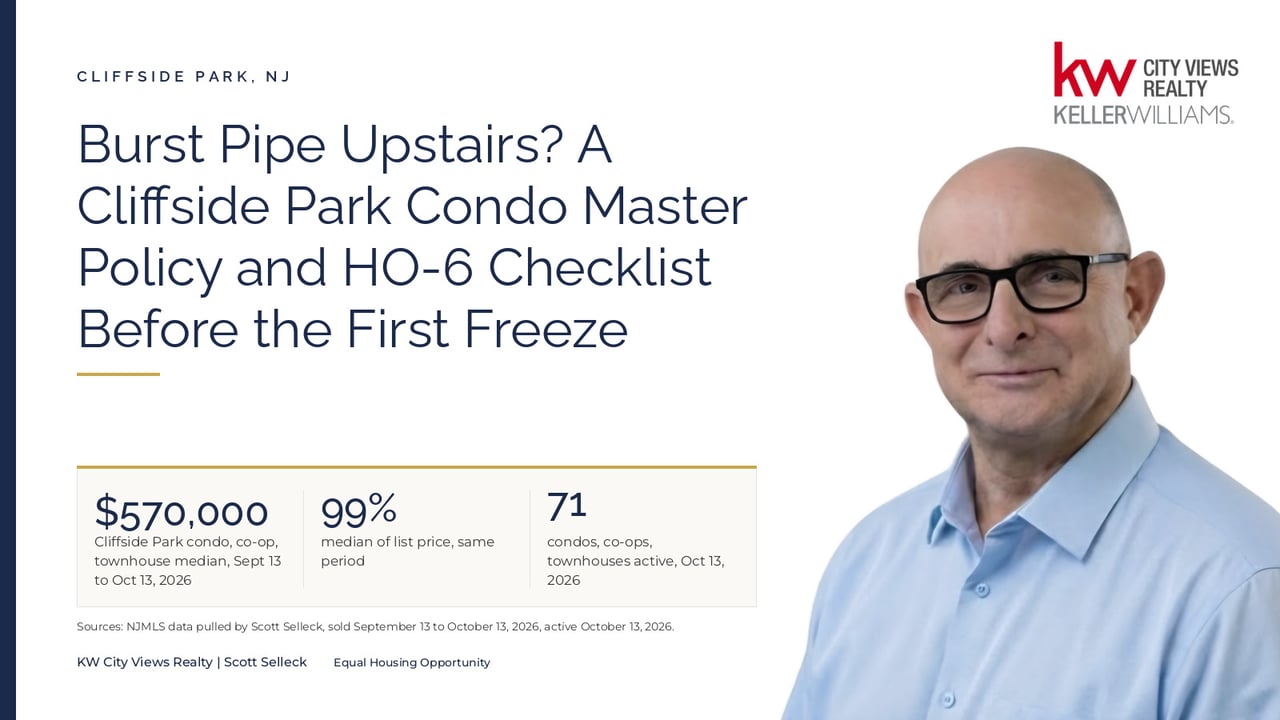
These papers also matter at sale time in Cliffside Park. Cliffside Park condos, co-ops and townhouses sold at a median of $570,000 on 16 sales, at a median 99% of list price, with 71 active, per NJMLS data pulled by Scott Selleck, sold September 13 to October 13, 2026, active October 13, 2026. Buyers and their attorneys commonly ask for the building's insurance documents during a sale, so having them ready helps whether you stay or sell.
Our posts on selling a condo with a special assessment in NJ and on what NJ condo owners are paying in special assessments under the 2025 reserve law cover the other side of building finances, and our 7 questions to ask before you buy a condo near the George Washington Bridge covers the purchase side.
Coverage, limits and deductibles vary by policy, building and carrier. Confirm yours in writing with your insurance agent or carrier before winter.
The Three Pillars Behind Every Good Decision
Every real estate decision sits where timing, lifestyle, and finances meet. Start with the first and work through all three.
Timing and Strategy
Do this review in October or November, before the first hard freeze and before winter travel. Coverage changes take time to put in place.
Lifestyle and Location Fit
A unit you live in all winter, a unit you leave empty for weeks and a unit you rent out each raise different coverage questions. Tell your insurance agent or carrier how the unit is used.
Financing and Cash-Flow
Add up what you could owe out of pocket after a leak: your HO-6 deductible, any share of the master deductible and any assessment. Then decide whether higher limits make sense.
Frequently Asked Questions
Does my HO-6 cover water from the unit above?
Often, for sudden and accidental water damage, which DOBI lists among covered losses. Coverage still depends on your policy wording, limits and deductible, and on what the master policy covers first. Ask your insurance agent or carrier to confirm.
Are frozen pipes covered in a New Jersey condo policy?
The DOBI summary lists freezing pipes as not covered unless the water was shut off or the building was heated. Keep the heat on and confirm your policy's wording.
What is loss assessment coverage?
DOBI lists loss assessment as an optional coverage that companies may offer. It can help pay your share of certain association assessments, depending on your policy wording and limits. Check whether your HO-6 includes it and the limit.
Where do I get the master policy for my Cliffside Park building?
Ask the management office or the association's board for the current declarations page or certificate of insurance. Ask for the master deed and bylaws at the same time.
Weighing a sale or a purchase this winter? Take the Seven-Question Assessment (7 questions, about 90 seconds), or Request an appointment.
For more on each town, see the Community Guides and the full library at SelleckSellsNJ.com.
Have a quick question first? Ask my AI assistant on Delphi. It is an AI trained on my material, not a person.
Scott Selleck
Broker Sales Associate | The Selleck Group | KW City Views Realty
Seniors Real Estate Specialist® (SRES®) | e-PRO® | Licensed since 1993. Over 500 transactions closed.
NJ Real Estate Broker Sales Associate License #9236275.
2200 Fletcher Avenue, Suite 502, Fort Lee, NJ 07024
Cell: (201) 970-3960 | Office: (201) 592-8900
Email: [email protected]
Website: SelleckSellsNJ.com
Request an appointment: meet.sellecksellsnj.com
AI assistant: https://www.delphi.co/scottselleck
My story: coverstory.sellecksellsnj.com | Verified career record: record.sellecksellsnj.com
NJ Real Estate Broker Sales Associate License #9236275. Licensure does not imply endorsement. Keller Williams City Views Realty. Each office is independently owned and operated. Broker compensation in New Jersey is fully negotiable and is not set by law or by any board or association of REALTORS®. This article is general information only and is not legal, tax, or financial advice. Confirm your own costs with your real estate attorney, tax advisor, or lender. Equal Housing Opportunity.
Coverage descriptions are summarized from the NJ Department of Banking and Insurance summary re-checked October 16, 2026, which states that it does not alter any policy. Your policy is the contract. Town figures are NJMLS data pulled by Scott Selleck and are not an appraisal. The featured image is a branded graphic. Its three figures are the NJMLS figures cited in the post.
Sources
- NJ Department of Banking and Insurance, Condominium Unit Owners Insurance summary of notable coverages and exclusions (Exhibit B), re-checked October 16, 2026. nj.gov/dobi
- NJ Department of Banking and Insurance, "Insuring Your Home," a consumer guide to homeowners, renters and condominium insurance, re-checked October 16, 2026. Insuring Your Home (PDF)
- NJMLS data pulled by Scott Selleck, sold September 13 to October 13, 2026, active as of October 13, 2026, Cliffside Park condo, co-op and townhouse (16 sold, 71 active). Not publicly available.
Three pillars. One calm process.
Every client conversation begins with timing, lifestyle fit, and cash-flow, so the decision becomes a clear plan instead of a guess.
Compare towns before the next move.
Use the Community Guides to weigh Bergen and Hudson County towns before you commit.
Equal Housing Opportunity | The Selleck Group | KW City Views Realty