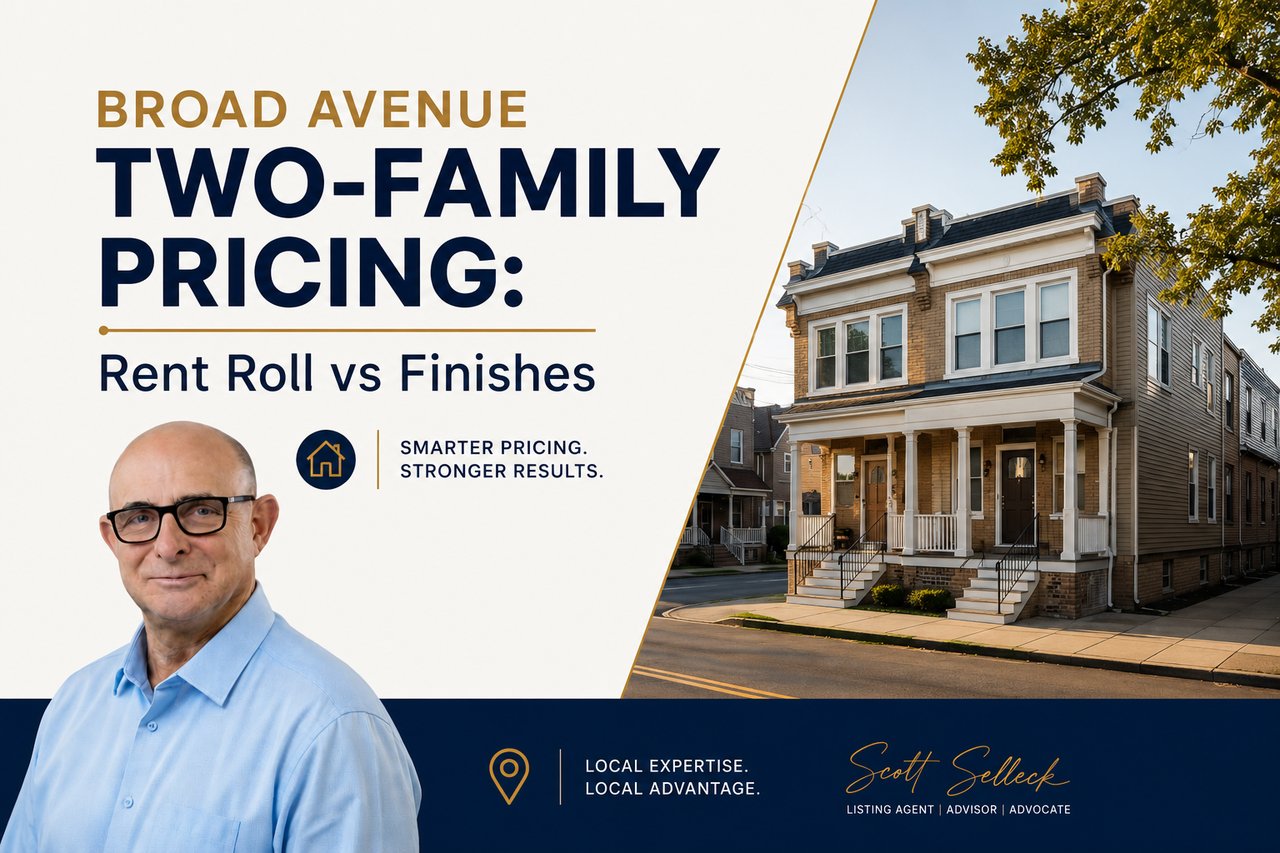
I tell every seller in this corridor the same thing: I judge a listing on evidence, comps, income documentation, and a written plan for what happens if the first week is slow, not on how nice the kitchen looks. That discipline matters even more when you are selling a two-family on a corridor street where the buyer pool is almost entirely investor-driven.
Why Broad Avenue Buyers Think in Yield, Not Finishes
The buyer for a Broad Avenue two-family is almost never someone who plans to gut-renovate and flip it for a retail end-user. The buyer is typically an investor or small developer underwriting the deal on income and land value. That changes everything about how you should position the property.
According to RentMarker's Bergen County rental analysis, investors targeting Northern New Jersey income properties are benchmarking against a gross yield of roughly 4.4 percent before costs for Bergen County rentals in 2026. That yield lens means the buyer's first question is what the property earns and what it can earn. The second question, what the kitchen looks like, comes much later, if at all.
Bergen County's median rent reached $2,916 per month as of mid-2026, up from $2,830 in February 2026, with year-over-year rent growth running around 3.2 percent. For a two-unit building, that income base, two units at or above county median rents, is the foundation of value.
For a conservative baseline, the FY 2026 HUD Fair Market Rent documentation for the Bergen-Passaic metro area lists FMRs of approximately $2,324 for a two bedroom and $2,835 for a three bedroom. Market rents on Broad Avenue for well-maintained units typically run above these benchmarks, which is exactly the spread a buyer wants to see: current rents that exceed the federal floor, with room to grow.
What the Broad Avenue Market Is Actually Pricing
Portal data as of mid-2026 shows Palisades Park multi-family asking prices ranging roughly from $1.2 million to $2.5 million, with a median around $1.6 million, and roughly 14 active multi-family listings anchoring that same range. These are portal figures rather than official MLS data, but they give you a working sense of where corridor assets are being positioned.
One telling data point: 402 Broad Avenue listed in January 2026 at $1,749,888 and went pending in roughly two weeks. That is fast absorption for a high-price asset, and it supports the idea that buyers respond to clear income and location narratives rather than cosmetic presentation.
The assessor's treatment of these properties tells the same story. Public records for a Broad Avenue multi-family show a land assessment alone of approximately $1.125 million. When the land by itself is assessed at seven figures, you are not selling a house. You are selling an income asset with embedded land value.
Buildable Value: The Third Leg of the Stool
Rent roll is the first leg. Gross yield is the second. Buildable value is the third, and on a corridor street like Broad Avenue it can move the needle significantly.
Broad Avenue is a primary mixed-use corridor. Parcels there often sit on lots large enough to attract small developers evaluating not just the existing two-family income but the potential for additional units, mixed-use conversion, or higher-density redevelopment. When you are marketing to that buyer, your pitch includes lot size, frontage, zoning category, and any variance history, not the age of the appliances.
Exact zoning parameters should be verified against the current Palisades Park land use code directly. That is something I work through with every seller before we set a price. More on the borough and the corridor is in the Palisades Park town guide.
For more context on how income-property math differs from standard residential pricing, my post on the North Bergen two-family math walks through why the area median sale price can be misleading when you are pricing an income asset.
The Rent Regulation Question, Answered Correctly
There is a piece of misinformation circulating about this, and it matters enough to be precise.
New Jersey enacted P.L.2025, c.85, approved July 1, 2025, which limits rent increases to no more than three and one half percent over a 12-month period on what the statute calls a covered dwelling site. That phrase is doing a lot of work. The statute defines a covered dwelling site as a parcel of land within a manufactured home park that is leased to the owner of a manufactured home or a modular or industrialized building.
In other words, it is a manufactured home park law. A conventional two-family house on Broad Avenue is not a covered dwelling site, and the statewide three and one half percent cap does not reach it. Sections 1 through 3 also remain inoperative until the first day of the eighth month following enactment, and the act applies to tenancies commencing on or after that effective date.
What does govern your property is local rent regulation, and that is a municipal question. The New Jersey Department of Community Affairs 2025 rent control survey notes that many New Jersey municipalities exempt owner-occupied two, three, and four family dwellings from local rent control, but that exemption is not universal and each ordinance differs. If your Broad Avenue property is owner-occupied and qualifies for an exemption, that is a meaningful piece of the pricing narrative worth documenting upfront, after it has been verified against the Palisades Park ordinance.
I am a real estate broker, not an attorney. Confirm the ordinance analysis with a New Jersey real estate attorney before it goes into a marketing package or an underwriting model.
How to Pitch Growth Without Overpromising
Even without a statewide cap on your property, aggressive rent growth projections are a weak pitch to a sophisticated buyer. Buyers in this corridor build their own models, and a seller's optimistic assumptions get replaced during due diligence anyway.
The stronger position is a rent roll that is already at or near market rate, with documented lease terms, and realistic growth assumptions the buyer can verify. Sell on the current income being real and documented, the unit mix being solid, and the lot having redevelopment optionality. That is a more durable pitch than upside that may or may not materialize.
If units are occupied, the tenancy travels with the building, which changes both your buyer pool and your documentation burden. I covered that in selling tenant-occupied property in Bergen and Hudson.
If you are weighing whether to update units before listing or sell as-is, my post on what actually pays off in Bergen County breaks down the calculus.
Bergen County Market Context in 2026
Area-level median sale prices across nearby towns are of limited use here, because those medians are dominated by single family and condo stock that prices on entirely different logic than a corridor multi-family. The band-by-band picture across the county is in what your budget actually buys in Bergen County.
What is worth noting is the bifurcation. A July 2026 investment analysis found single family median prices in Bergen County rose about 3.5 percent to roughly $851,000, while townhouse and condominium medians fell about 4.8 percent to roughly $475,000 with inventory up 24 percent. County median figures vary by source and by metric, since some report all property types and others report single family only, so compare like with like before drawing conclusions.
That split matters for Broad Avenue sellers. Two-family corridor assets positioned on rent roll and buildable value can compete favorably against softening condominium inventory, even when cosmetic finishes are modest.
Your specific number, what this property should ask and what it will likely trade at, depends on your actual rent roll, lease terms, unit mix, lot dimensions, and zoning. That is the conversation I work through with every seller before we set a number, and it starts with a current valuation that treats the property as an income asset rather than a house.
You can read what past clients have said about working with me on Google or Zillow.
Ready to Price Your Corridor Property?
If you are ready to see where your Broad Avenue property stands, take the seven-question assessment at quiz.sellecksellsnj.com, or book a consultation and I will pull the income comps and the buildable-value analysis for your specific address.
The Three Pillars Behind Every Smart Sale
Every real estate decision sits where timing, cash-flow, and lifestyle fit meet. Work all three or the math stops holding.
Timing & Strategy
Get leases current and income documented before the listing goes live, not during due diligence. Start with the seven-question assessment at quiz.sellecksellsnj.com.
Financing & Cash-Flow
Rent roll, gross yield, and buildable lot value are the three numbers that set the price. See the advisory approach at scott.sellecksellsnj.com.
Lifestyle & Location Fit
Broad Avenue is a mixed-use corridor, and the lot narrative is part of what the buyer is buying. Compare towns in the guides at communityguides.sellecksellsnj.com.
Frequently Asked Questions
What is the going price range for two-family or multi-family homes on Broad Avenue in Palisades Park right now?
Portal data as of mid-2026 shows Palisades Park multi-family asking prices roughly in the $1.2 million to $2.5 million range, with a median around $1.6 million. One Broad Avenue property listed at $1,749,888 in January 2026 went pending in about two weeks, which suggests well-priced income-oriented assets move quickly. These are portal figures for general context. Your specific property's value depends on rent roll, lot size, unit mix, and zoning.
Do buyers in Palisades Park care more about modern finishes or about income and zoning potential?
For Broad Avenue corridor properties, the buyer pool is predominantly investor-oriented, and those buyers underwrite on income and land value first. Bergen County investors are benchmarking against gross yields around 4 to 4.5 percent before costs, which means a strong rent roll matters far more than updated kitchens or bathrooms. A modest-finish property with at-market rents and a developable lot will typically outperform a renovated unit with below-market rents in this buyer pool.
Does New Jersey's 2025 statewide rent increase cap apply to my Palisades Park two-family?
Almost certainly not. P.L.2025, c.85, approved July 1, 2025, caps rent increases at three and one half percent over a 12-month period for covered dwelling sites, and the statute defines a covered dwelling site as a parcel within a manufactured home park leased to the owner of a manufactured or modular home. A conventional two-family house on Broad Avenue does not fit that definition. Confirm your specific situation with a New Jersey real estate attorney rather than relying on a summary.
Are owner-occupied two-family houses on Broad Avenue treated differently for rent control in New Jersey?
Many New Jersey municipalities exempt owner-occupied two, three, and four family dwellings from local rent control, according to the New Jersey Department of Community Affairs 2025 rent control survey. That exemption is not universal and each town's ordinance is different. If your property is owner-occupied and qualifies for a local exemption, that is a meaningful piece of the pricing narrative, but it needs to be verified against the Palisades Park ordinance before you present it to buyers.
Does it make sense to update kitchens and baths before selling a Broad Avenue two-family?
For an income property on a corridor street, renovation dollars rarely return as much as they would on a single family retail sale. Investor buyers are pricing on rent roll and lot value, so a $40,000 kitchen renovation is unlikely to move the needle the way it would for a homeowner buyer. The better use of pre-sale effort is usually getting leases current, documenting income clearly, and confirming the zoning and lot narrative.
This article is general information only and is not legal, tax, or financial advice. Rent figures, portal listing data, and assessment records are drawn from the cited sources on the dates noted and change over time. Zoning, rent control applicability, and any owner-occupancy exemption must be verified against the current Palisades Park ordinance and land use code. Scott Selleck is licensed as a Real Estate Broker in New Jersey, broker since 1998 and licensed since 1993, and as a Florida Sales Associate #SL3588731 since 2023 with Keller Williams Boca Raton Realty, regulated by the New Jersey Real Estate Commission. Broker compensation is fully negotiable and is not set by law or by any board or association of Realtors. Confirm your own numbers with your attorney, tax advisor, lender, or closing officer.
Top 5 Sources
- P.L.2025, c.85, New Jersey rent increase limits for covered dwelling sites, approved July 1, 2025.
- New Jersey Department of Community Affairs 2025 rent control survey of municipal ordinances.
- RentMarker Bergen County rental analysis and FY 2026 HUD Fair Market Rent documentation for the Bergen-Passaic metro area.
- Scott Selleck Foundation Document for voice, positioning, and advisory framing.
- Scott Selleck Link Directory for CTA structure, internal linking, and required site references.