The Selleck Group | KW City Views Realty
Scott Selleck · Broker / Sales Associate · Request an appointment at meet.sellecksellsnj.com
Serving Bergen and Hudson County · SRES®, e-PRO® · Licensed since 1993. Over 500 transactions closed.
If you own a co-op in Fort Lee and your sale price could land above $1,000,000, a state fee belongs in your pricing decision from the start.
Does New Jersey's $1 million Graduated Percent Fee apply to a Fort Lee co-op sale?
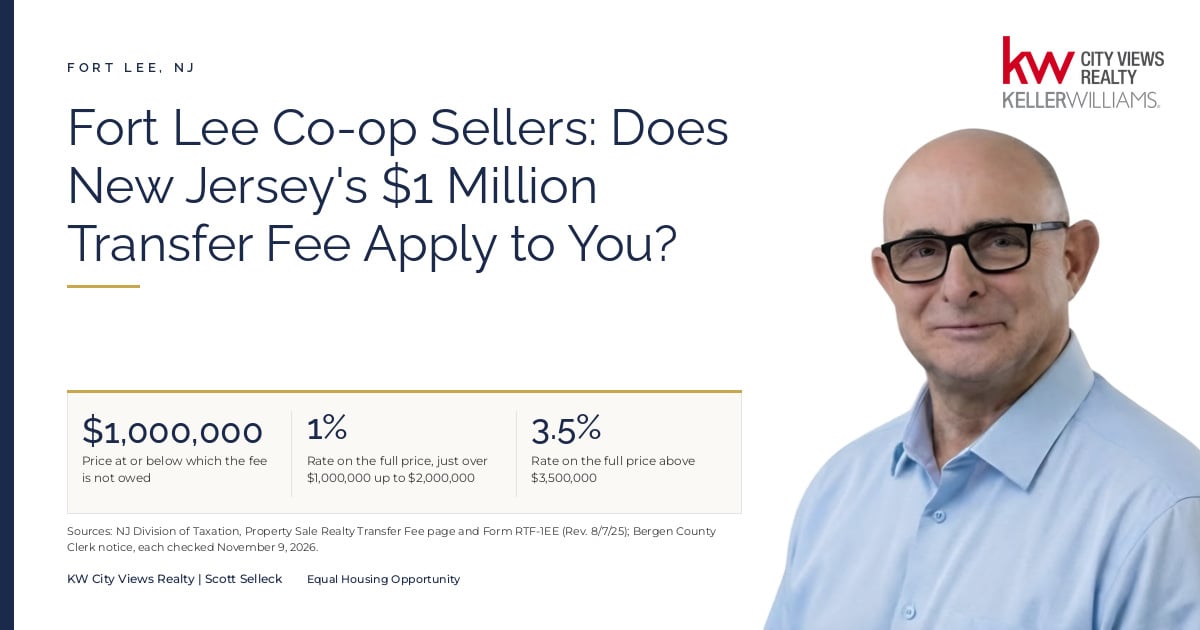
Short answer: Yes. New Jersey's Graduated Percent Fee covers Class 4C cooperative units, not only deeded houses and condominiums, when the sale price is over $1,000,000, and the seller pays it. The rate runs from 1 percent of the entire price just above $1,000,000 to 3.5 percent above $3,500,000. A co-op selling for $1,000,000 or less does not owe it.
Updated November 9, 2026. Source: NJ Division of Taxation, Property Sale Realty Transfer Fee page and Form RTF-1EE (Rev. 8/7/25); Bergen County Clerk notice, each checked November 9, 2026.
What is New Jersey's Graduated Percent Fee?
It is a state fee on the sale of real property for more than $1,000,000, and the seller is responsible for it. The Bergen County Clerk announced that the graduated schedule took effect July 10, 2025. The Division of Taxation states it plainly: "The seller is statutorily responsible for the RTF and the Graduated Percent Fee."
On a deeded sale over $1,000,000, that means two separate charges. The regular Realty Transfer Fee, which sellers already paid, and the Graduated Percent Fee on top of it. How each one is handled when co-op shares change hands is a question for your closing attorney. If you read an older article describing a 1 percent fee paid by the buyer, it is describing the rule before this change. Our full Bergen County explainer covers how the seller fee changed and what it does to a net sheet.
Does the fee really apply to a co-op, where no deed is recorded?
Yes. The Division of Taxation names "Class 4C cooperative units" as covered property, and the state's Affidavit of Consideration for the fee, Form RTF-1EE, includes "a cooperative unit as defined in section 3 of P.L. 1987, c. 381 (C.46:8D-3)."
Worth pausing on. A co-op sale transfers shares and a proprietary lease rather than a deed, so many owners assume deed-based fees skip them. For this fee, the state says otherwise. Exactly how it is calculated and collected at your co-op closing is a mechanics question for your closing attorney, and it is the first question I would ask before you set a price.
How much is the fee at each price level?
The rate applies to the total price, not only the portion above each threshold. Cross a line by one dollar and the higher rate applies to the whole sale. Here are the bands as the Division of Taxation publishes them:
Sale price | Graduated Percent Fee |
|---|---|
$1,000,000 or less | Not owed |
Over $1,000,000 up to $2,000,000 | 1% of total price |
Over $2,000,000 up to $2,500,000 | 2% of total price |
Over $2,500,000 up to $3,000,000 | 2.5% of total price |
Over $3,000,000 up to $3,500,000 | 3% of total price |
Over $3,500,000 | 3.5% of total price |
A co-op that sells for $1,200,000 owes $12,000. At $2,000,000 the fee is $20,000. At $2,050,000 it is $41,000, because the 2 percent rate now applies to the full price.
What should a Fort Lee co-op seller do before pricing near $1,000,000?
Build the net sheet before you choose the list price. A price just above a threshold can net you less than a price just below it, so the number on the listing should be a decision, not a round figure picked for marketing.
Here is what I would do:
- Ask your closing attorney to confirm the fee and the regular Realty Transfer Fee at two or three candidate prices.
- Ask the managing agent for any building charges tied to a sale. Many co-op buildings set their own transfer rules in their governing documents, and they are separate from the state fee. We looked at how two Fort Lee co-ops set opposite rules in their own policies.
- Compare the net, not the gross, at each candidate price. Then decide.
Can the buyer pay the fee instead?
The statutory responsibility sits with the seller. Whether a buyer agrees to absorb some of that cost is a negotiation and a contract question, and the answer depends on how much competition your unit has. Put any such term in writing through the attorneys, never as a side agreement.
What should you ask a listing agent about this fee?
Ask the agent to show you a net sheet with the fee at your likely price before you sign a listing agreement. An agent who prices co-ops near $1,000,000 should be able to explain where the threshold sits and what it costs you on each side of it. Our guide on how to choose a listing agent in Fort Lee lists the other questions worth asking in that first meeting.
By the Numbers
- July 10, 2025: effective date of the graduated fee schedule (Bergen County Clerk notice).
- $1,000,000: the price at or below which the Graduated Percent Fee is not owed (NJ Division of Taxation, accessed November 9, 2026).
- 1%: the rate on the full price from just over $1,000,000 up to $2,000,000 (NJ Division of Taxation).
- 3.5%: the rate on the full price above $3,500,000 (NJ Division of Taxation).
- Class 4C cooperative units: listed by the Division of Taxation as covered property.
- Form RTF-1EE, revised August 7, 2025: the affidavit filed for sales over $1,000,000 (NJ Division of Taxation).
The Bottom Line
If your Fort Lee co-op could sell for more than $1,000,000, the fee belongs in your pricing decision from the first conversation. Run the net at more than one price before you list. The right number is the one that leaves you the most after every charge, not the one that looks good on the listing.
Check It Yourself
- NJ Division of Taxation. The Realty Transfer Fee page lists the Graduated Percent Fee rates, the covered property classes, including Class 4C cooperative units, and states that the seller is responsible for the fee.
- Form RTF-1EE. The Affidavit of Consideration for the Graduated Percent Fee (Rev. 8/7/25) lists the exemptions and is filed with every sale over $1,000,000. It is on the Division of Taxation's Realty Transfer Fee forms page.
- Bergen County Clerk. The Clerk's notice announces the graduated fee schedule effective July 10, 2025.
Frequently Asked Questions
Do Fort Lee co-op sellers pay the New Jersey Graduated Percent Fee?
Yes, when the sale price is over $1,000,000. The NJ Division of Taxation lists cooperative units as covered property and names the seller as statutorily responsible.
Is the fee charged only on the amount above $1,000,000?
No. The rate applies to the total price. A $1,200,000 sale owes 1 percent of $1,200,000, which is $12,000.
Does a co-op that sells for exactly $1,000,000 owe the fee?
No. The fee applies to consideration in excess of $1,000,000.
Is this the same as the regular Realty Transfer Fee?
No. The Graduated Percent Fee is a supplemental fee on top of the regular Realty Transfer Fee, and the Division of Taxation names the seller as responsible for both. Ask your closing attorney how each one applies at a co-op closing.
I am a licensed real estate agent, not a tax professional or attorney. Confirm the fee, any exemption, and how it is collected at a co-op closing with your attorney before acting on it.
Sources: NJ Division of Taxation, Property Sale Realty Transfer Fee page (nj.gov/treasury/taxation/realty.shtml), accessed November 9, 2026. NJ Division of Taxation, Form RTF-1EE (Rev. 8/7/25). Bergen County Clerk, Realty Transfer Fee notice, https://www.bergencountyclerk.gov/News/View/2342, accessed November 9, 2026.
Three pillars. One calm process.
Every client conversation begins with timing, how the home fits your plans, and cash-flow, so the decision becomes a clear plan instead of a guess.
Compare towns before the next move.
Use the Community Guides to weigh Bergen and Hudson County towns before you commit.
Meet with Me
Start with a number you can trust: Request a home valuation and ask me to show the fee at your likely price, or take the seven-question resource quiz, which takes about 90 seconds. When you are ready to talk it through, Request an appointment.
For more on each town, see the Community Guides and the full library at SelleckSellsNJ.com.
Have a quick question first? Ask my AI assistant on Delphi. It is an AI trained on my material, not a person.
Scott Selleck
Broker / Sales Associate | The Selleck Group | KW City Views Realty
SRES® (Seniors Real Estate Specialist®) | e-PRO® | Licensed since 1993. Over 500 transactions closed.
2200 Fletcher Avenue, Suite 502, Fort Lee, NJ 07024
Cell: (201) 970-3960 | Office: (201) 592-8900
Email: [email protected]
Website: SelleckSellsNJ.com
Request an appointment: meet.sellecksellsnj.com
AI assistant: https://www.delphi.co/scottselleck
My story: coverstory.sellecksellsnj.com | Verified career record: record.sellecksellsnj.com
NJ Real Estate Broker Sales Associate License #9236275
Licensure does not imply endorsement. FL Real Estate Sales Associate License #SL3588731, Keller Williams Boca Raton Realty. Keller Williams City Views Realty and Keller Williams Boca Raton Realty. Each office is independently owned and operated. Broker compensation in New Jersey is fully negotiable and is not set by law or by any board or association of REALTORS®. This article is general information only and is not legal, tax, or financial advice. Confirm your own costs with your real estate attorney, tax professional, or lender. Equal Housing Opportunity.
NJ License #9236275 KW City Views Realty | FL License #SL3588731 Keller Williams Boca Raton Realty | Equal Housing Opportunity
#ScottSelleckRealtor #BergenCountyRealtor #NorthernNJRealtor #KWCityViews