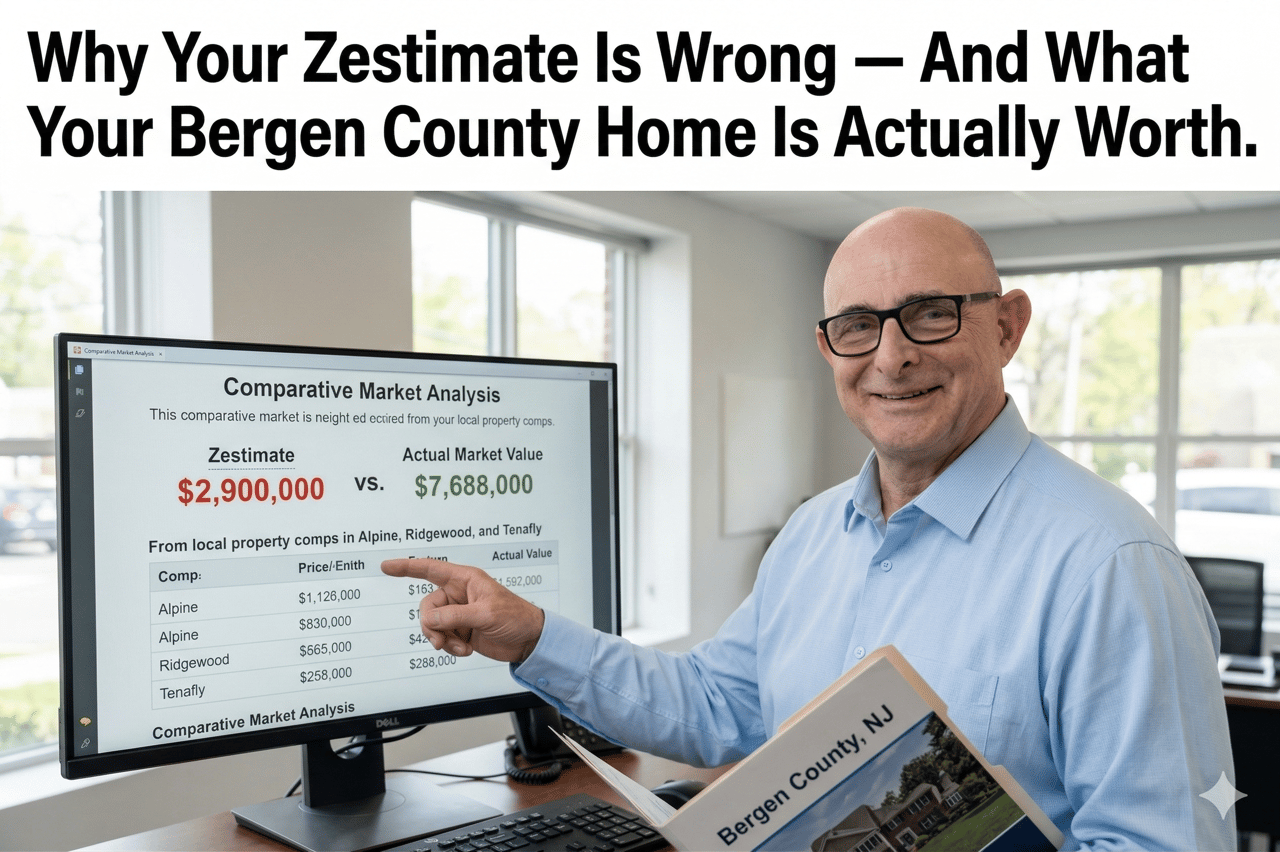
Why Your Zestimate Is Wrong — And What Your Bergen County Home Is Actually Worth
How accurate is Zillow's Zestimate for Bergen County, NJ homes? Zillow's own data shows a median error rate of 2–4% nationally for on-market homes — but for off-market properties in markets with significant variability like Bergen County, NJ, the error can be substantially larger, sometimes missing by $50,000 to $150,000 or more in either direction.
You've looked it up. Maybe more than once.
You pull up your address on Zillow, see a number, and spend the next ten minutes deciding how you feel about it. Too high and it seems unrealistic. Too low and it feels like an insult.
Here's the thing: either reaction might be right. Because the Zestimate is not an appraisal, not a comparative market analysis, and not a professional opinion of value. It's an algorithm. And in Bergen County, where two homes on the same street can differ by $200,000 based on factors no algorithm can see, that algorithm has real limitations.
This post explains exactly why — and tells you what actually determines what your home is worth.
What the Zestimate Actually Is
Zillow's Zestimate is a machine learning model that estimates home values using publicly available data. It ingests information like recent sale prices in the area, property tax records, square footage, bed and bath count, and year built — then applies statistical modeling to produce a number.
Zillow is transparent about this. On its own website, the company publishes its median error rates by market. Nationally, the Zestimate has a median error rate of roughly 2–4% for on-market homes. For off-market properties — homes not currently listed — that error rate climbs. In some markets and some ZIP codes, Zillow's own published accuracy data shows error rates exceeding 6–8%.
On a $900,000 Bergen County home, a 6% error is $54,000. On a $1.2 million home, it's $72,000.
That's not a rounding error. That's a real financial gap that affects what you list at, what you walk away with, and whether you leave money on the table or overprice yourself out of the market.
Why Bergen County Is Particularly Hard for Algorithms
National automated valuation models are calibrated to work across millions of properties in markets with broad comparables — think suburban Phoenix, where houses in the same subdivision are nearly identical and sell frequently. Bergen County is the opposite of that.
70 Municipalities, 70 Micro-Markets
Bergen County has 70 municipalities. They range from Alpine — with a median home value among the highest in the state — to towns with entirely different price profiles just a few miles away. Within those towns, individual streets, exposures, proximity to commercial corridors, lot size, and views all create price variation that ZIP code-level data can't capture.
The Zestimate doesn't know that a home on the west side of a particular street in Tenafly backs to a busy road. It doesn't know that two nearly identical colonials in Leonia differ by $75,000 because one has been fully renovated and the other hasn't been touched since 1987. It doesn't know that the unit on the 22nd floor in a Fort Lee high-rise commands a premium over the identical unit on the 4th floor because of the Hudson River view.
These are the factors that experienced local agents price for every day. They are invisible to an algorithm working from public records.
Bergen County Homes Don't Sell Frequently Enough
Automated models depend on transaction volume to stay calibrated. In high-turnover markets, there are enough recent sales to triangulate an accurate estimate. In Bergen County, where many homeowners have lived in the same property for 15, 20, or 30 years, the comparable sales data is thinner — and the algorithm has less to work with.
When the last sale on your street was three years ago and the market has moved meaningfully since then, the Zestimate is extrapolating from stale data. That extrapolation can go wrong in both directions.
Condition Is Invisible to Zillow
Perhaps the single biggest failure of automated valuations is that they cannot account for condition.
Your home and your neighbor's home may have identical bed counts, bath counts, square footage, and lot size. But if yours has been fully renovated — updated kitchen, new bathrooms, new HVAC, refinished floors — and theirs is original throughout, the market will price that gap at $100,000 or more in a Bergen County context.
Zillow doesn't know that. It sees two similar properties and models something in between. If your home is the renovated one, you're being undervalued. If yours is the original, you may be overvalued.
Neither outcome serves you.
The Zestimate Can Hurt You in Both Directions
Most homeowners worry about the Zestimate being too low. That's a real concern — an artificially low automated estimate can anchor a seller's expectations downward before they've even spoken to an agent, or give a buyer a data point to argue against a well-supported asking price.
But an inflated Zestimate creates a different problem that's just as damaging.
When a homeowner sees a Zestimate that's $100,000 above what the market will actually support, they often go to market at or near that number — and then sit. Days on market accumulate. The listing goes stale. Agents and buyers start wondering what's wrong with the property. A price reduction follows. And a home that might have sold quickly at the right price ends up selling for less than it would have, because the overpriced period damaged its market position.
Pricing a home correctly from day one is one of the most important things a listing agent does. It requires real data, real judgment, and real knowledge of what buyers are actually paying in your specific market right now. The Zestimate provides none of those things.
What Actually Determines Your Bergen County Home's Value
A professional Comparative Market Analysis — what agents call a CMA — is built on a completely different foundation than an automated valuation.
A CMA examines actual closed sales of genuinely comparable properties within a relevant geographic and time frame. "Comparable" in Bergen County means similar in type, size, condition, lot, and location — not just ZIP code proximity. It accounts for:
Condition and updates. A renovated kitchen, updated bathrooms, new roof, new HVAC — these add real value that a CMA captures and an algorithm misses.
Lot and location specifics. Corner lot vs. interior lot. Backs to a park vs. backs to a highway. End unit vs. middle unit. High floor vs. low floor. These distinctions matter in Bergen County pricing and require human judgment to apply correctly.
Days on market and list-to-sale ratio. A skilled agent doesn't just look at what homes sold for — they look at how quickly they sold and whether they sold above or below asking. That tells you what the market is actually doing at your price point right now.
Active competition. What else is available in your price range in your town? If there are three similar homes listed at $850,000 and they're all sitting, that's information. If there are none and qualified buyers are actively looking, that's different information.
Recent market direction. Bergen County prices have been moving. A CMA anchored to sales from 12 months ago may undervalue your home if prices have risen, or overestimate it if conditions have shifted.
None of this is available in a Zestimate.
A Real-World Example of the Gap
Consider a 4-bedroom colonial in Paramus. The Zestimate shows $820,000. A professional CMA, run by an agent who knows the Paramus market, accounts for a recent kitchen renovation, a larger-than-average lot, and the fact that comparable sales have been running strong in the $875,000–$920,000 range over the past 90 days.
The correctly priced listing goes to market at $899,000. It receives multiple offers in the first two weeks and closes at $915,000.
The homeowner who trusted the Zestimate and listed at $820,000 left $95,000 on the table. The homeowner who overreacted to an inflated Zestimate and listed at $950,000 sat on the market for 90 days, took a price reduction, and ultimately closed at $880,000 after the stale listing cost them negotiating leverage.
Correct pricing — grounded in real data and local expertise — is where value is protected or lost.
FAQ
Is the Zestimate ever accurate for Bergen County homes? It can be close, particularly for properties in high-turnover neighborhoods where recent comparable sales are plentiful and homes are relatively uniform in size and condition. But even in those cases, condition, specific location, and recent market movement introduce gaps. It should be treated as a starting reference point, not a pricing decision.
Why does Zillow publish a Zestimate if it knows it can be inaccurate? Zillow's business model depends on generating leads from homeowners and buyers who engage with their platform. The Zestimate is an engagement tool — it gives people a reason to visit the site and return regularly. Zillow publishes its own error rate methodology, which confirms the limitations, but most casual users don't read that disclosure.
How do I get an accurate valuation for my Bergen County home? The most accurate non-appraisal valuation comes from a local agent with direct experience in your town and price range who can build a CMA from current, relevant comparable sales. It costs nothing and takes less time than you'd expect. The alternative — making a pricing decision based on an automated estimate — is one of the most common and expensive mistakes Bergen County sellers make.
Will a professional valuation obligate me to list my home? No. A home valuation conversation is exactly that — a conversation. Understanding what your home is worth in the current market is useful information regardless of your timeline or whether you ultimately decide to sell.
Find Out What Your Home Is Actually Worth
The Zestimate is a starting point at best. At worst, it's a number that costs you real money — either by anchoring you too low or by sending you to market at a price the data doesn't support.
Scott Selleck, REALTOR® with The Selleck Group at KW City Views Realty, has been pricing Bergen County and Hudson County homes for 34 years. A professional market valuation from someone who knows your town, your street, and your current buyer pool is a different tool entirely — and it's available to you at no cost.
If you're curious what your home is actually worth right now, start there.
Call or text 201-970-3960 | [email protected] | SelleckSellsNJ.com
Request your complimentary Bergen County Home Valuation at www.SelleckSellsNJ.com