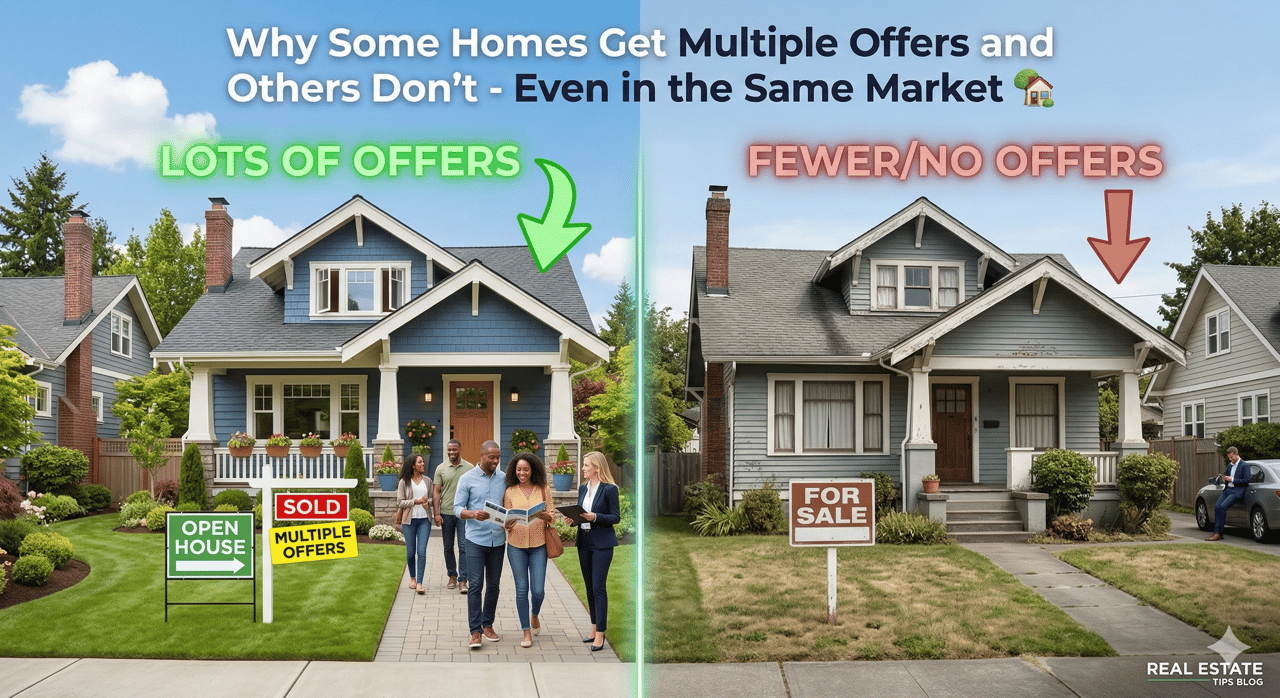
Why Some Homes Get Multiple Offers and Others Don’t - Even in the Same Market 🏡
In any given market, a pattern consistently emerges. Some homes attract immediate attention, generate multiple offers, and sell with strong terms. Others, often similar in size, location, and price range, sit longer and struggle to gain traction.
This creates confusion for many homeowners. If the market is active, why do outcomes vary so widely?
The answer lies in positioning, perception, and strategy, not just market conditions.
Understanding these differences can help sellers avoid missed opportunities and create the kind of demand that leads to stronger results.
Demand Is Created, Not Assumed
A common misconception is that a “hot market” guarantees strong offers. In reality, buyer demand is highly selective.
Even in competitive conditions, buyers compare options carefully. They gravitate toward homes that feel well-prepared, appropriately priced, and aligned with their expectations.
Homes that generate multiple offers typically do not do so by accident. They are intentionally positioned to create interest and competition.
The Power of First Impressions
The first few days on the market are critical.
When a home launches, it is exposed to the largest pool of active buyers. These are the people who have been waiting, watching, and ready to act. If a property captures their attention immediately, it can generate strong showing activity and early offers.
If it does not, that initial momentum is lost.
First impressions are shaped by:
-
Professional photography and visual presentation
-
Condition and cleanliness of the home
-
Staging or layout optimization
-
Curb appeal and exterior condition
Buyers often form opinions within seconds of viewing a listing online. That initial reaction determines whether they schedule a showing or move on.
Pricing Strategy Drives Traffic
Pricing is one of the most influential factors in determining whether a home attracts multiple offers.
Homes that receive strong interest are typically priced in a way that aligns with buyer expectations and recent comparable sales. This creates a sense of opportunity.
In contrast, homes that are priced too high often experience reduced showing activity. Buyers may skip them entirely, waiting to see if price reductions occur.
Interestingly, strategic pricing does not mean underpricing. It means positioning the home within a range that encourages engagement and competition.
The Role of Micro-Location
Even within the same town or neighborhood, subtle differences can impact buyer behavior.
In areas like Bergen County, factors such as street positioning, traffic flow, privacy, school proximity, and walkability can influence perception.
Two homes with similar features may receive very different levels of interest based on how buyers interpret these location details.
Recognizing and highlighting micro-location strengths can help a property stand out.
Condition and “Move-In Readiness”
Today’s buyers often prioritize convenience. Many prefer homes that feel ready for immediate occupancy, even if they plan to make changes later.
Properties that are clean, well-maintained, and thoughtfully presented tend to generate stronger emotional responses.
Homes that require visible updates or repairs may still sell, but they often attract a smaller pool of buyers and less competitive offers.
The goal is not perfection. It is minimizing friction in the buyer’s decision-making process.
Marketing That Reaches the Right Buyers
Exposure matters, but targeted exposure matters more.
Homes that generate multiple offers are typically marketed in a way that reaches both active and potential buyers. This includes:
-
High-quality digital marketing
-
Agent-to-agent outreach
-
Pre-market interest generation
-
Strategic timing of the listing launch
The objective is to concentrate attention, not dilute it.
Showing Experience and Accessibility
Sometimes overlooked, the showing experience can influence results.
Homes that are easy to show, available on short notice, and presented consistently well tend to receive more traffic.
Limited showing availability or inconsistent presentation can reduce momentum, even if the home itself is strong.
Convenience plays a role in buyer behavior.
Buyer Psychology and Competition
Multiple offers are often driven by psychology as much as logic.
When buyers perceive competition, they may act more decisively. They may submit stronger offers, reduce contingencies, or adjust timelines to improve their chances.
This sense of urgency is created when:
-
There is visible showing activity
-
Interest appears high early on
-
The home feels like a strong value relative to alternatives
Without that perception, buyers may take a wait-and-see approach.
Why Similar Homes Perform Differently
When two comparable homes achieve different results, the explanation is rarely a single factor.
More often, it is a combination of:
-
Slight differences in pricing
-
Variations in presentation
-
Timing of the listing
-
Marketing effectiveness
-
Buyer perception of value
Small details can create meaningful differences in outcome.
Can Demand Be Increased After Listing?
If a home does not generate strong interest initially, adjustments can be made.
These may include:
-
Re-evaluating pricing strategy
-
Improving presentation or staging
-
Updating marketing materials
-
Repositioning the listing with a refreshed approach
However, it is always more effective to create strong demand from the beginning than to rebuild it later.
A More Strategic Approach for Sellers
Sellers who consistently achieve strong results tend to follow a structured process:
-
Prepare the home thoughtfully before listing
-
Position pricing based on market data and buyer behavior
-
Launch with high-quality marketing
-
Maximize early exposure and accessibility
-
Monitor feedback and adjust quickly if needed
This approach increases the likelihood of attracting serious buyers and generating competitive offers.
Final Thoughts
Multiple offers are not simply a result of market conditions. They are the outcome of careful planning, strategic positioning, and strong execution.
In a market like Bergen County, where buyer expectations are high and competition varies at a micro level, details matter.
Sellers who understand how demand is created can move beyond hoping for strong results and instead take steps to actively generate them.
The difference between one offer and several is often not the home itself. It is how the home is presented, priced, and introduced to the market.