What Happens to Bergen County Home Prices When Mortgage Rates Drop?
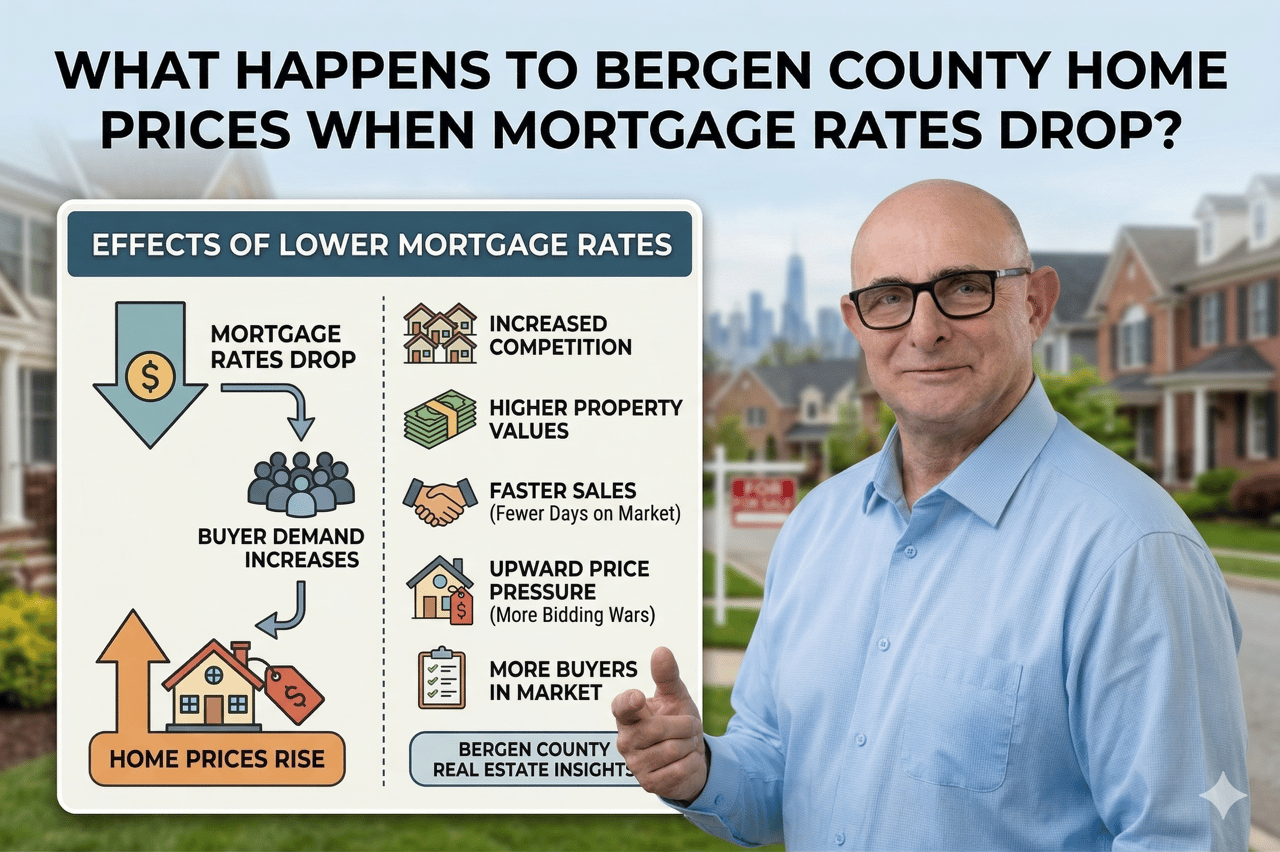
Do Bergen County home prices go up when mortgage rates fall? In Bergen County, NJ, lower mortgage rates historically increase buyer demand and purchasing power, which puts upward pressure on prices — particularly in inventory-constrained markets. However, the relationship is not simple or instant: rates affect buyer behavior, but Bergen County's chronic inventory shortage means prices have stayed elevated even at higher rate levels.
It's the question every Bergen County homeowner has been asking for two years.
"Should I wait until rates come down?"
Sometimes sellers ask it. Sometimes buyers ask it. And the answer in both cases is more nuanced than the headlines suggest — because the relationship between mortgage rates and Bergen County home prices is not a simple inverse lever where rates go down and prices automatically go up.
Here's what actually happens.
First, Understand Who Bergen County Buyers Actually Are
To predict what rate changes do to Bergen County home prices, you need to understand who is buying here.
Bergen County is not a first-time buyer market at the median. The buyers who are most active in the $700,000–$1.2 million range are typically move-up buyers from within the region, NJ renters converting to ownership, and buyers relocating from New York City. Many have significant down payments — in some cases, substantial equity from a prior sale.
There is also a meaningful all-cash buyer presence in Bergen County, particularly for high-end single-family homes and Gold Coast condos. These buyers are not affected by mortgage rates at all.
The rate sensitivity in Bergen County is most pronounced at the lower end of the price range — the first-time buyer who needs maximum financing — and least pronounced at the higher end, where cash and large down payments dominate.
This matters because a rate drop that dramatically expands the first-time buyer market in a national context has a more muted direct effect on Bergen County's mid-to-upper price ranges.
What Lower Rates Actually Do to Demand
When rates fall, three things tend to happen in Bergen County's market — and they don't all happen at once or at the same magnitude.
Buyers who were waiting on the sidelines re-enter
During the 2022–2024 rate elevation cycle, a meaningful cohort of Bergen County buyers paused their search. They were pre-approved at lower rates, found the carrying costs at 7%+ unattractive, and decided to wait. These buyers don't disappear — they accumulate. When rates fall, they re-enter quickly, often all at once.
That re-entry is a demand surge. It compresses the already-limited inventory in Bergen County and creates more competitive conditions for available listings.
Existing homeowners consider moving
The lock-in effect — where homeowners with 3% mortgages are reluctant to sell and take on a 7% mortgage — has meaningfully suppressed Bergen County inventory. When rates fall, some of those homeowners become sellers. That adds inventory, which partially offsets the demand surge.
The net effect depends on which force moves faster and further. If buyers re-enter faster than inventory appears, prices rise. If new inventory floods the market at the same time demand picks up, prices stabilize.
Purchasing power increases for financed buyers
A buyer approved for a $700,000 mortgage at 7% may qualify for $800,000 at 5.5%. That expanded purchasing power means they can compete for homes they couldn't previously afford — which puts more competition on the inventory that was previously at the top of their range.
In Bergen County, where the difference between a $700,000 and $800,000 budget can mean the difference between certain towns and certain property types, this is a meaningful shift.
The Inventory Problem: Why Bergen County Doesn't Behave Like a Normal Market
Here's the structural reality that makes Bergen County different from most markets when analyzing rate effects.
Bergen County has a chronic inventory shortage. The number of homes for sale relative to the number of qualified buyers has been below normal for most of the past decade, with the gap widening during the pandemic and remaining constrained through 2025. The reasons are structural: it's a built-out suburban county adjacent to one of the most expensive cities in the world, where landowners have no incentive to build and long-tenure homeowners have been reluctant to sell into a high-rate environment.
When a market has deeply constrained inventory and rates drop, the demand surge meets a wall. There simply aren't enough homes to absorb the new buyers, so prices go up — sometimes quickly.
Bergen County has demonstrated this dynamic repeatedly. Even at elevated rates in 2023 and 2024, well-priced homes in desirable towns attracted multiple offers because the buyer pool remained strong relative to available supply. A rate drop that brings more buyers into that environment without a proportional increase in homes for sale is a price-upward pressure event.
What This Means for Sellers: The Rate Drop Is Not a Reason to Wait
Bergen County sellers who are waiting for rates to drop before listing have the logic backwards.
Lower rates bring more buyers. More buyers mean more competition for your home. More competition means stronger offers and potentially faster timelines. That's the argument for selling into a rate-drop environment — not for waiting until after one materializes and all the buyers who were on the sidelines have already re-entered.
The sellers who benefit most from a rate drop are the ones who have their homes on the market when the buyers flood back in — not the ones who listed three months later when inventory had caught up with demand.
Waiting for a better market is a strategy that makes sense in some contexts. In Bergen County's supply-constrained environment, where well-positioned homes are already moving at strong prices, it's more likely to cost sellers time than to gain them anything.
What This Means for Buyers: Move Before the Competition Does
Buyers waiting for rates to drop to enter the Bergen County market are making a bet that lower rates will make homes more affordable. The bet may not pay off the way they expect.
Lower rates expand purchasing power — but they also bring every other buyer back into the market at the same time. If rates drop from 7% to 5.5% and the Bergen County market responds with 20% more buyer activity on the same constrained inventory, prices move up. The affordability gain from the lower rate is partially or fully offset by higher purchase prices.
Buyers who enter a strong Bergen County market before a widely anticipated rate drop are often better positioned than those who wait — because they're competing against fewer buyers and negotiating from a position of less urgency.
FAQ
Will Bergen County home prices drop if mortgage rates stay high? Bergen County home prices have remained elevated despite higher rates due to persistent inventory constraints and sustained buyer demand from NYC-area residents seeking suburban alternatives. A significant price correction would require either a substantial increase in available inventory or a major demand shock — neither of which has materialized. Prices have moderated slightly from peak levels but have not declined meaningfully.
How much do mortgage rates affect affordability in Bergen County? At Bergen County's median price point of roughly $755,000 with 20% down, a 1.5 percentage point rate reduction from 7% to 5.5% reduces the monthly principal and interest payment by approximately $500–$600 per month. That's meaningful for financed buyers, though less significant for the all-cash buyers who represent a larger share of the Bergen County market than in most regions.
Is now a good time to sell in Bergen County given the rate environment? Bergen County's supply-constrained market has sustained strong prices even through elevated rate periods. Well-priced, well-prepared homes continue to attract qualified buyers and competitive offers. The timing question for any individual seller depends on their personal circumstances, equity position, and destination plans — not on a specific rate level. Waiting for rates to fall before selling has historically cost Bergen County sellers more in time than it has gained them in price.
Know Where the Market Stands Before You Decide
Rate trends matter. But they're one input among several in a well-considered selling or buying decision — not the controlling variable that overrides everything else.
Scott Selleck, REALTOR® with The Selleck Group at KW City Views Realty, tracks Bergen County and Hudson County market conditions daily and can give you a clear, data-backed picture of where things stand in your specific town and price range right now.
If you're trying to decide whether this is the right time to move, that conversation is worth having.
Call or text 201-970-3960 | [email protected] | SelleckSellsNJ.com