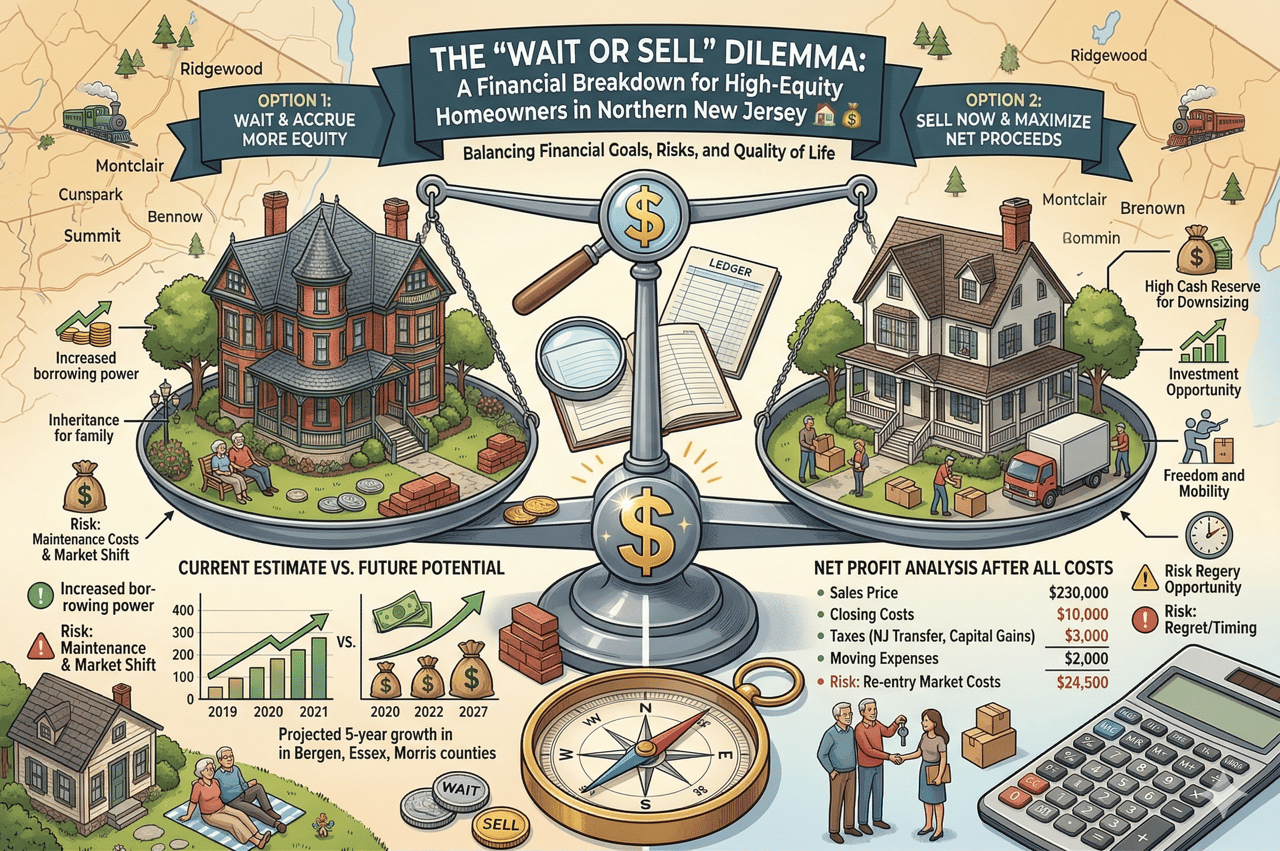
The “Wait or Sell” Dilemma: A Financial Breakdown for High-Equity Homeowners in Northern New Jersey 🏡💰
For many long-time homeowners, one question continues to surface:
Should I sell now, or wait?
At first glance, it seems like a market timing decision. Interest rates, home values, and economic forecasts often dominate the conversation. But for homeowners with substantial equity, the real decision is more nuanced.
It is not just about market conditions. It is about how your equity is working for you, and what waiting actually costs over time.
Understanding the Position of High-Equity Homeowners
Many homeowners in Bergen County and surrounding areas purchased their homes years, or even decades, ago. As a result, they are often sitting on significant unrealized gains.
This creates flexibility, but it can also create indecision.
On one hand, there is comfort in staying put. On the other, there is awareness that equity could be repositioned to support lifestyle goals, reduce expenses, or create new opportunities.
The challenge is determining whether waiting improves or limits those options.
The Illusion of “Waiting for the Perfect Market”
It is natural to want to sell at the peak. However, identifying the exact top of a market in real time is extremely difficult.
Home values move in cycles. Interest rates fluctuate. Inventory levels shift. Waiting for ideal conditions can sometimes lead to missed opportunities rather than improved outcomes.
More importantly, focusing only on future appreciation ignores the broader financial picture.
The Opportunity Cost of Waiting
One of the most overlooked factors in this decision is opportunity cost.
Every year a homeowner delays a move, several financial elements continue to accumulate:
-
Property taxes
-
Maintenance and upkeep
-
Insurance costs
-
Potential renovation expenses
-
Carrying costs relative to lifestyle needs
While the home may appreciate, these ongoing costs reduce the net financial benefit of waiting.
In some cases, homeowners find that the additional equity gained over time is partially offset by the cost of holding the property longer than necessary.
Equity Is Only Valuable When It Is Utilized
Home equity can feel like wealth, but it is not fully functional until it is deployed.
Selling a home allows that equity to be converted into:
-
A smaller, more manageable property
-
A debt-free or lower-cost housing situation
-
Investment opportunities
-
Lifestyle flexibility, including relocation or travel
The key question becomes:
Is your current home supporting your future goals, or simply holding your equity in place?
Lifestyle Alignment Matters More Than Timing
Financial considerations are important, but they are only part of the equation.
Many homeowners delay selling even when their current home no longer aligns with their lifestyle. This may include:
-
Maintaining more space than needed
-
Managing ongoing upkeep that no longer feels practical
-
Delaying relocation closer to family or preferred locations
-
Postponing downsizing plans
In these cases, waiting may not improve quality of life. It may simply extend a situation that no longer fits.
When Waiting Can Make Sense
There are situations where holding a property longer may be a reasonable choice.
For example:
-
If a homeowner has a very low fixed housing cost
-
If the property serves a clear long-term purpose
-
If there are near-term changes that would impact timing (such as job transitions or family needs)
However, even in these scenarios, it is valuable to revisit the decision regularly rather than defaulting to inaction.
The Risk of Delayed Decisions
Waiting without a clear plan can introduce risk.
Market conditions can shift. Personal circumstances can change. Health, mobility, or financial priorities may evolve in ways that make future moves more complicated.
In some cases, homeowners who delay too long find themselves making decisions under pressure rather than on their own terms.
Proactive planning helps avoid reactive outcomes.
A Practical Framework for Decision-Making
Instead of focusing solely on “wait or sell,” a more effective approach is to evaluate the decision through multiple lenses:
1. Financial Position
-
What is your estimated equity today?
-
How would selling impact your overall financial picture?
2. Cost of Staying
-
What are your annual carrying costs?
-
How do these compare to alternative living options?
3. Lifestyle Fit
-
Does your current home support your daily needs and future plans?
4. Market Conditions
-
Are current conditions favorable for your property type and location?
5. Flexibility
-
Would selling now create more options or fewer?
This framework shifts the focus from prediction to clarity.
The Benefit of Early Planning
One of the most effective strategies for high-equity homeowners is starting the conversation early.
Even if a move is not immediate, understanding your position allows for:
-
Better preparation
-
More strategic timing
-
Reduced stress when the decision is made
-
Greater control over the process
Planning ahead transforms the decision from reactive to intentional.
The Role of Strategic Guidance
Because this decision involves both financial and lifestyle considerations, working through the process with experienced guidance can be valuable.
Objective input can help clarify:
-
Realistic home value and net proceeds
-
Timing scenarios based on current conditions
-
Downsizing or relocation options
-
Potential risks and opportunities
The goal is not to push a decision, but to provide the information needed to make the right one.
Final Thoughts
The “wait or sell” question is not just about timing the market. It is about understanding how your home fits into your broader financial and lifestyle goals.
For high-equity homeowners in Northern New Jersey, the opportunity is not simply to maximize price. It is to maximize outcome.
Waiting may feel safe, but it is not always neutral. It has both costs and consequences.
Selling, when aligned with a clear plan, can create flexibility, simplify life, and unlock opportunities that may not be available otherwise.
The most effective decisions are not driven by headlines. They are driven by clarity, preparation, and a strategy that reflects what matters most to you.