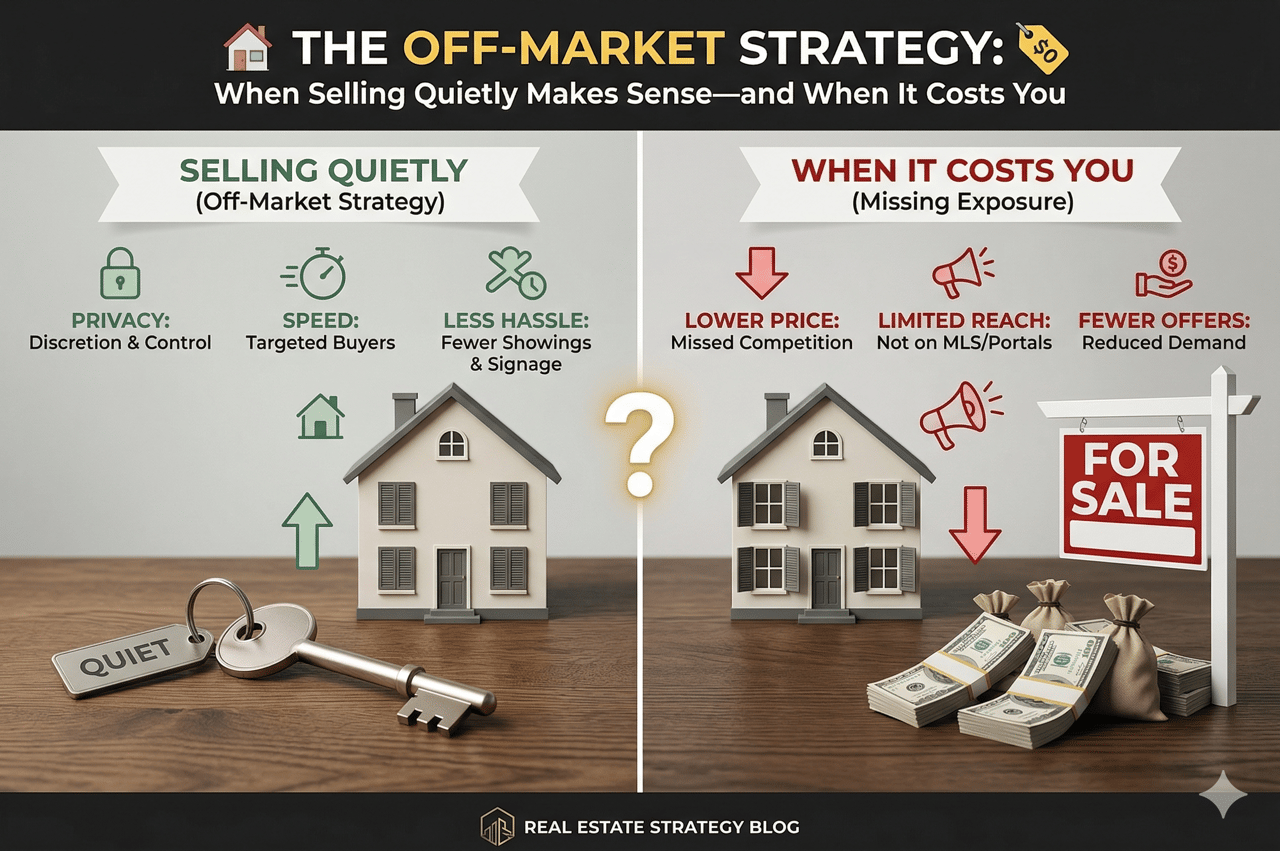
The Off-Market Strategy: When Selling Quietly Makes Sense—and When It Costs You 🏡
Not every home sale begins with a public listing.
In many markets, including Bergen County, there is a growing interest in off-market transactions, also known as private or “quiet” sales. These are properties that are marketed selectively, often through agent networks or direct outreach, without being widely exposed on the open market.
For some sellers, this approach can feel appealing. It offers discretion, convenience, and potentially a faster path to a deal.
However, the off-market strategy is not always the right choice. In some cases, it can limit opportunity and reduce final sale outcomes.
Understanding when this approach works—and when it does not—is critical to making an informed decision.
What Is an Off-Market Sale?
An off-market sale occurs when a property is not publicly listed on the MLS or major real estate platforms.
Instead, exposure is limited to:
-
Private agent networks
-
Direct buyer outreach
-
Select marketing channels
-
Pre-existing buyer relationships
These transactions are often driven by connections rather than broad visibility.
Why Some Sellers Consider Selling Quietly
There are several reasons homeowners explore off-market options:
1. Privacy Concerns
Some sellers prefer to avoid public exposure, especially in higher price ranges or unique personal situations.
2. Convenience
Off-market sales can reduce the need for frequent showings, open houses, and ongoing home preparation.
3. Testing the Market
Some sellers want to gauge interest before committing to a full listing strategy.
4. Speed
In certain situations, a quick, direct transaction may be more important than maximizing price.
These are all valid considerations. The key is understanding the trade-offs.
The Primary Advantage: Simplicity
The biggest benefit of an off-market sale is simplicity.
Fewer showings, fewer disruptions, and a more controlled process can make the experience feel easier, especially for homeowners balancing busy schedules or personal transitions.
In some cases, a well-qualified buyer may already exist within an agent’s network, allowing for a direct match without the need for broad exposure.
The Hidden Trade-Off: Reduced Competition
The most important factor in achieving a strong sale price is competition.
When multiple buyers are aware of a property, they create upward pressure on price and terms. This is what drives multiple offers and strong negotiating positions.
Off-market sales, by definition, limit that exposure.
Fewer buyers seeing the property means:
-
Fewer offers
-
Less urgency
-
Reduced leverage in negotiations
Even if a buyer is interested, they may not feel the need to act aggressively if they believe there is no competition.
Pricing Without Market Feedback
Another challenge with off-market sales is pricing accuracy.
When a home is publicly listed, the market provides immediate feedback through showings, inquiries, and offers. This data helps validate or adjust pricing strategy.
In an off-market scenario, that feedback is limited.
Sellers may accept an offer without fully understanding whether stronger opportunities existed.
When Off-Market Selling Makes Sense
There are situations where an off-market approach can be appropriate.
1. Highly Specific Buyer Match
If a qualified buyer is already identified and strongly aligned with the property, a direct transaction may be efficient.
2. Unique Personal Circumstances
Privacy, family situations, or timing constraints may justify a quieter process.
3. Testing Early Interest
Some sellers explore off-market exposure as a preliminary step before deciding on a full launch.
4. Properties With Limited Appeal
In certain cases, where a home may not benefit significantly from broad exposure, a targeted approach can be effective.
When It May Cost You
In many cases, especially for well-located and desirable homes in Bergen County, limiting exposure can reduce potential upside.
Off-market selling may cost you when:
-
Demand for your property type is strong
-
Inventory is limited
-
Your home has broad buyer appeal
-
Multiple offers are likely with proper marketing
In these situations, public exposure often creates the best opportunity for maximizing value.
The Hybrid Approach: Testing Without Limiting
Some sellers benefit from a hybrid strategy.
This may involve:
-
Pre-marketing within agent networks
-
Quietly gauging interest
-
Preparing the home fully for market
If strong interest emerges, the seller can evaluate early offers. If not, the home is positioned for a full public launch.
This approach provides flexibility without committing too early to limited exposure.
The Role of Strategy and Timing
Off-market decisions should not be based solely on convenience. They should be part of a broader strategy.
Key considerations include:
-
Current market conditions
-
Buyer demand in your price range
-
Your personal timeline and goals
-
The level of preparation of your home
Timing also matters. A well-prepared home launched at the right moment often outperforms a quiet sale that limits visibility.
Emotional Factors and Control
Some homeowners are drawn to off-market sales because they feel more controlled.
Fewer showings, fewer unknowns, and a more private process can reduce stress. However, this sense of control can sometimes come at the expense of opportunity.
Balancing emotional comfort with financial outcome is an important part of the decision.
A Strategic Question to Ask
Instead of asking, “Should I sell off-market?” consider this:
“What is the best strategy to achieve my goals, given my timeline, my property, and current market conditions?”
For some, that answer may include a quiet approach. For others, it will clearly point toward full exposure.
Final Thoughts
Off-market sales are neither inherently good nor bad. They are simply one option within a broader set of strategies.
In a market like Bergen County, where demand, pricing, and competition can vary significantly from one property to another, the right approach depends on context.
The key is understanding the trade-offs.
Selling quietly may offer convenience and privacy. Selling publicly often creates competition and maximizes opportunity.
The most effective decisions come from aligning strategy with goals, not defaulting to one approach without considering the full picture.