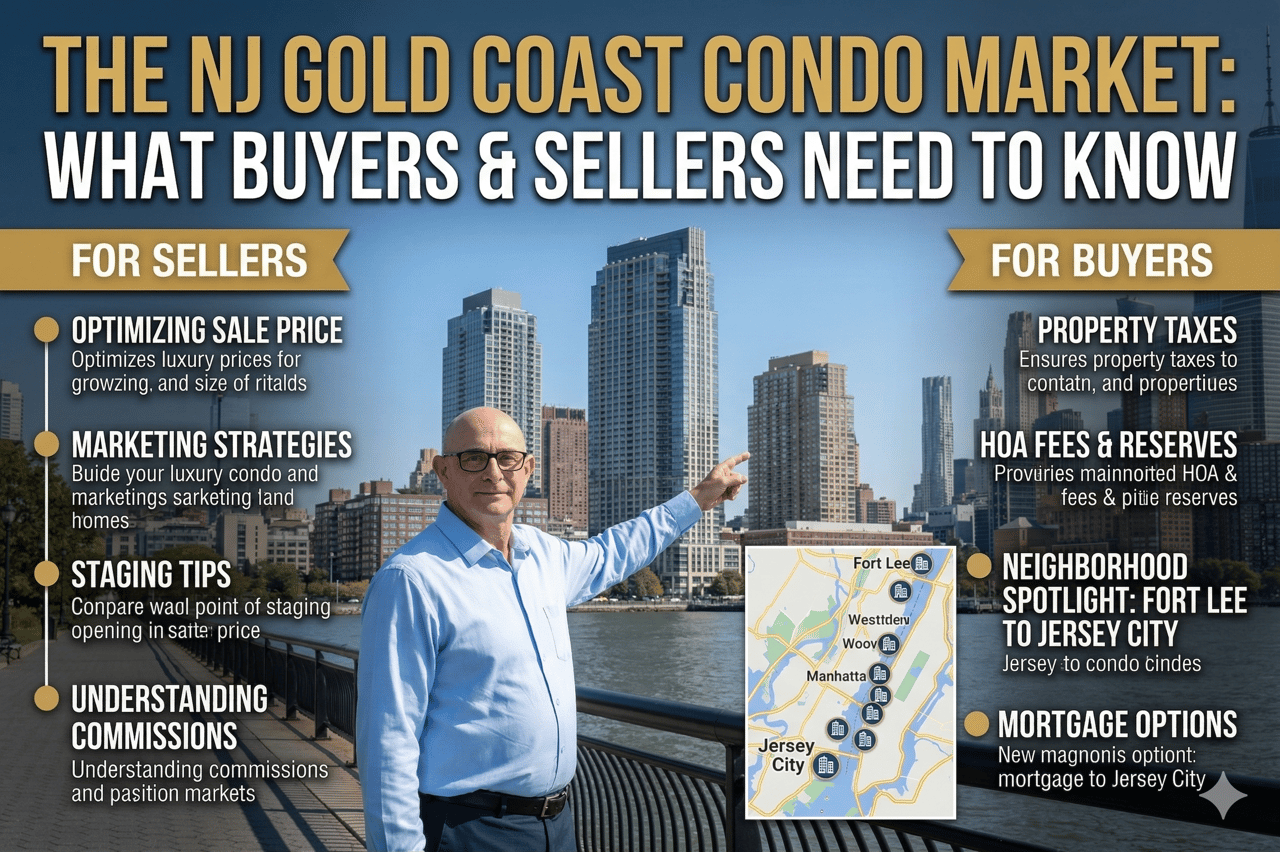
The NJ Gold Coast Condo Market: What Buyers and Sellers Need to Know From Fort Lee to Jersey City
What is the NJ Gold Coast real estate market and what are condos selling for there? The NJ Gold Coast is the stretch of Hudson County and southern Bergen County communities along the Hudson River — including Fort Lee, Edgewater, Cliffside Park, Weehawken, Hoboken, and Jersey City. Condo prices range widely by building, floor, view, and town, from the mid-$300s to over $2 million for luxury waterfront units.
There's a specific kind of buyer who finds the NJ Gold Coast.
They want Manhattan proximity without Manhattan prices. They want Hudson River views, modern finishes, and the ability to be in Midtown in 20 minutes. They want a lifestyle that feels urban without the cost and density of living inside the city itself.
And then there's the seller — the Gold Coast homeowner who bought in 2005 or 2012 and has watched the market evolve dramatically around them, wondering what their unit is actually worth now and what distinguishes a strong sale from an average one.
This post is for both.
What the Gold Coast Actually Is
The NJ Gold Coast is not an official municipality — it's a term for the corridor of high-density residential development that runs along the Hudson River in Hudson County and southern Bergen County. The communities that make up the Gold Coast include, from north to south:
Fort Lee (Bergen County) — The northernmost Gold Coast community, sitting directly adjacent to the George Washington Bridge. Fort Lee is the most Bergen County-like of the Gold Coast towns — lower density than communities further south, with a mix of high-rise condo and co-op buildings and single-family homes. Proximity to the GWB makes it a top commuter destination.
Edgewater (Bergen County) — Arguably the most lifestyle-forward of the Gold Coast communities. Edgewater's waterfront has been dramatically developed over the past two decades, with luxury condo towers, the Mitsuwa Marketplace, direct NYC ferry service, and restaurant density that rivals much larger markets. New construction has been active and prices reflect it.
Cliffside Park and Palisades Park (Bergen County) — Offering a more accessible price point than Fort Lee and Edgewater while maintaining the commuter corridor access and Hudson views from elevated positions. Both towns have seen significant condo development along the Palisade ridgeline.
North Bergen, West New York, and Guttenberg (Hudson County) — Transitional communities with a mix of older building stock and newer construction. Lower price points than Bergen County Gold Coast towns, with similar access to NYC via bus and ferry.
Weehawken and Union City (Hudson County) — Strong mid-market communities with direct ferry access to Midtown and Lincoln Tunnel proximity. Port Imperial in Weehawken is one of the most developed luxury waterfront communities in the region.
Hoboken and Jersey City (Hudson County) — The southernmost Gold Coast anchors. Hoboken is a dense, walkable, transit-rich community with a lifestyle all its own. Jersey City's downtown waterfront and Journal Square neighborhoods have seen enormous development investment and price appreciation over the past decade.
What Drives Value on the Gold Coast
Gold Coast condo value is not primarily about square footage. It's about a specific hierarchy of features that this market's buyers are willing to pay for.
View — and the specific quality of that view
A Hudson River view with direct Manhattan skyline exposure is the single most valuable feature in a Gold Coast building. The difference between a unit facing the river with a clear George Washington Bridge view and an identical unit facing inland can be $100,000 or more at the same address.
Within river-facing units, height matters. A 20th floor unit sees over adjacent buildings and captures the full skyline. A 5th floor unit may be partially obscured. Buyers price that difference, and sellers who present this distinction well capture a premium.
Parking
In Gold Coast communities, where building density is high and street parking is limited, a deeded or assigned garage parking space adds substantial value. One space can add $30,000–$60,000 in value in competitive buildings. Two spaces is a meaningful marketing advantage. No parking — or parking that is rented rather than deeded — is a real limitation that affects buyer pool and negotiating position.
Building quality and financial health
Gold Coast buyers — especially post-Surfside — are increasingly sophisticated about building financials. Reserve funds, maintenance records, pending assessments, ongoing litigation, and the overall condition of common areas all affect buyer confidence and lender willingness to finance.
A well-run building with a healthy reserve study, recent capital improvements, and no pending assessments commands a premium over comparable buildings with financial uncertainty. This is information sellers should be prepared to present proactively.
Commute access
Gold Coast condos derive significant value from Manhattan commute access. Buyers pay for the specific commute a building provides — GWB bus access, ferry terminals, PATH train proximity, and Lincoln Tunnel access all affect the building's buyer pool and therefore its pricing power.
The Pricing Landscape: What to Expect by Town
Generalizing Gold Coast pricing is difficult because variability within each town is high — a GWB-view penthouse in Fort Lee and a mid-floor interior unit in the same building can differ by $500,000. But as a general framework:
Fort Lee condos range from the mid-$300s for smaller, older co-op units to $1.5 million and above for luxury high-rise condos with full river and bridge views. The median sits roughly in the $450,000–$600,000 range for typical 1–2 bedroom units.
Edgewater newer construction has pushed pricing higher, with 2-bedroom luxury units commonly in the $700,000–$1.2 million range. Older buildings offer more accessible entry points.
Cliffside Park and Palisades Park offer entry points in the $350,000–$600,000 range for comparable unit sizes, with the Palisade ridge view premium adding above that for top-floor units.
Hoboken and Jersey City have their own pricing dynamics influenced by brownstone inventory, luxury high-rise development, and proximity to PATH. Downtown Jersey City and Hoboken waterfront units regularly transact above $700,000 for 2-bedrooms.
For Sellers: What Makes a Gold Coast Listing Succeed
The Gold Coast condo market rewards presentation and positioning more than most markets. Here's why.
Buyers in this price range are sophisticated and have options across multiple communities and buildings. They compare not just price per square foot but view quality, building amenities, parking, HOA structure, and commute. A listing that presents all of these elements clearly — and markets the view professionally with high-quality photography and virtual tours — attracts the buyer who is specifically looking for what your unit offers.
A listing that undersells the view with poor photography, buries the parking information in the MLS details, or fails to address building financial questions proactively will underperform relative to its actual market value.
Pricing matters too. The Gold Coast condo market has micro-market dynamics that vary floor by floor and facing by facing within a single building. An agent with direct experience in your specific building and comparable sales — not just ZIP code data — is the only one who can price your unit correctly.
FAQ
Is the NJ Gold Coast condo market a good investment? Gold Coast condos have shown strong appreciation over the past decade, driven by continued NYC commuter demand, waterfront development, and infrastructure investment. As with any real estate investment, return depends on purchase price, building quality, and holding period. Units in well-managed buildings with strong views and parking have consistently outperformed the broader NJ condo market.
What should Gold Coast condo buyers know about HOA fees? HOA fees on Gold Coast luxury buildings can be substantial — often $800–$1,500 per month for full-service buildings with concierge, gym, pool, and valet parking. Buyers should request the building's financial statements, reserve fund balance, and any pending assessments before committing. A building with low reserves relative to its age and deferred capital needs is a risk that HOA fees alone don't capture.
How do I find out if a Gold Coast condo building has any pending assessments or litigation? Request the building's meeting minutes, financials, and reserve study from the seller's agent as part of your due diligence. In New Jersey, sellers are required to provide certain disclosures about condominium associations. Your real estate attorney should review these documents before the attorney review period closes.
Thinking About Buying or Selling on the Gold Coast?
The NJ Gold Coast is one of the most dynamic and complex real estate markets in the region. Getting it right — whether you're buying your first waterfront unit or selling after 15 years — requires an agent who knows these buildings, these streets, and these buyers.
Scott Selleck, REALTOR® with The Selleck Group at KW City Views Realty, has been working across Bergen County and Hudson County's Gold Coast communities since 1993. If you have questions about a specific building, a pricing opinion, or what your current unit could sell for, start with a conversation.
Call or text 201-970-3960 | [email protected] | SelleckSellsNJ.com