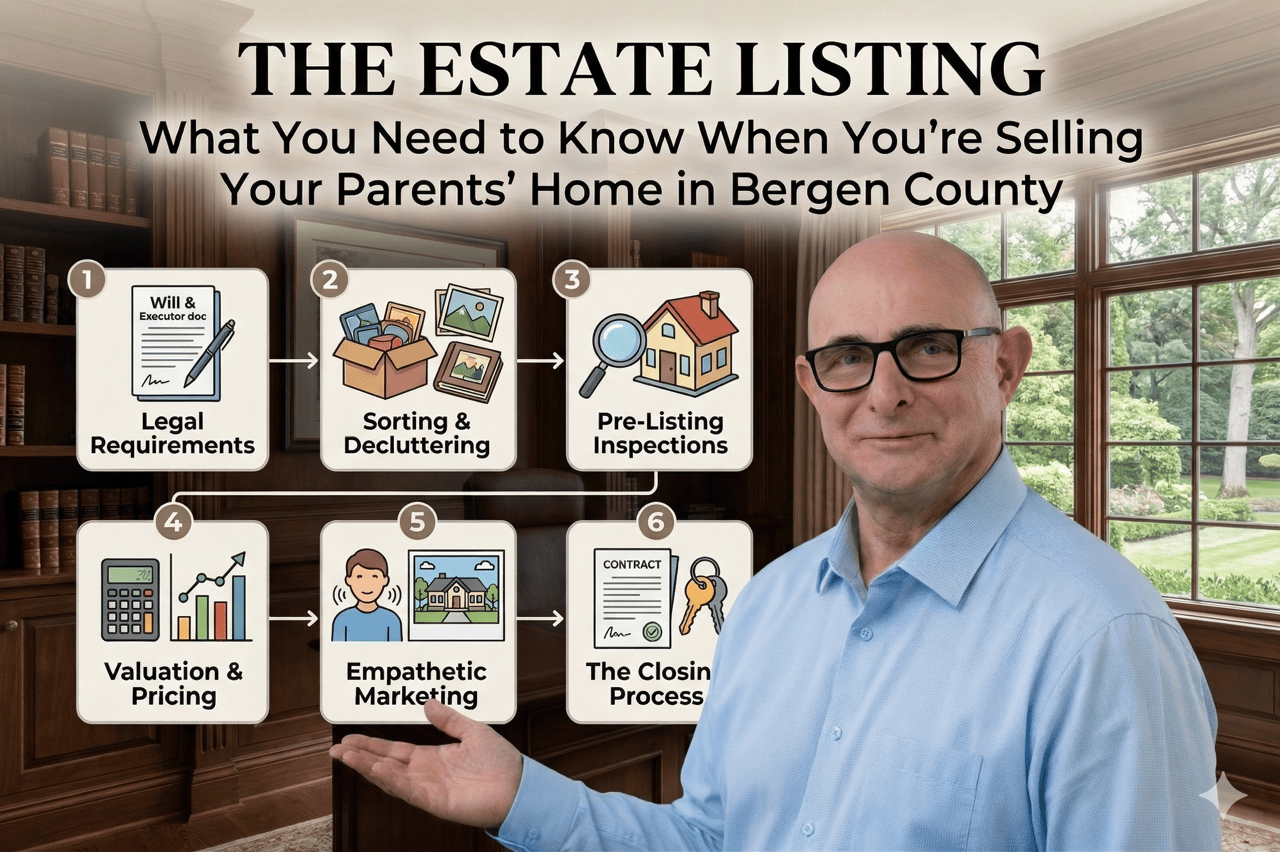
The Estate Listing: What You Need to Know When You're Selling Your Parents' Home in Bergen County
What do adult children need to know when selling a parent's home in Bergen County, NJ? Selling an inherited or estate property in Bergen County involves probate, title considerations, family decision-making, and emotional complexity that a standard home sale doesn't. Getting the process right starts before you call a listing agent.
Nobody prepares you for this.
One day you're a son or a daughter. Then a parent passes, or becomes unable to manage their affairs, and suddenly you're responsible for one of the most emotionally weighted transactions of your life — selling the house you grew up in, or the home your parents spent 40 years building equity in.
It's a different kind of sale. Legally. Emotionally. Practically.
And in Bergen County, where long-tenure homeowners have significant equity in homes that haven't been on the market in decades, it's a situation that comes up more often than most people realize.
This post is for the adult children — the executors, the trustees, the siblings trying to coordinate — who are navigating this process and aren't sure where to start.
The Legal Layer Comes First
Before you can list, price, or show a parent's home, you need clarity on who has the legal authority to sell it.
This is where most estate sales slow down or get complicated, and it almost always comes back to one question: did your parent have a will or a trust?
If there's a will
A will must go through probate in New Jersey before the property can be sold. Probate is the court process that validates the will, appoints an executor (or confirms the named executor), and authorizes that person to act on behalf of the estate.
In New Jersey, probate is handled through the Surrogate's Court in the county where the deceased resided. In Bergen County, that's the Bergen County Surrogate's Court in Hackensack. The process is generally straightforward for uncontested estates, but it takes time — typically several weeks to a few months before the executor has the legal authority to sign a listing agreement or a contract of sale.
Don't skip this step. A title company will not close on an estate sale without proper probate documentation.
If there's a trust
A home held in a revocable living trust avoids probate entirely. The successor trustee — the person named to take over after the original trustee passes — has immediate authority to manage and sell the property. This is one of the primary reasons estate planning attorneys recommend trusts for real estate-owning clients.
If your parent had a trust and the home is titled in the trust's name, the process can move significantly faster.
If there's no will
This is the most complicated scenario. When someone dies without a will in New Jersey, their estate is distributed according to state intestacy laws, and an administrator must be appointed by the Surrogate's Court. This process takes longer and can create friction among family members who may have different expectations about the property.
If you're in this situation, an estate attorney is not optional. It's essential.
The Emotional Layer Is Real — and It Affects Decisions
Let's be direct about something that real estate professionals often dance around.
Selling a family home is not like selling a house. It's the kitchen where your mother cooked. It's the backyard where your children played. It's 40 years of accumulated life, and the act of pricing it, showing it to strangers, and accepting an offer can feel like a betrayal — even when it's clearly the right thing to do.
That emotional weight shows up in decisions. Sellers hold out for numbers the market won't support because the price feels like a statement about the home's worth, not just its value. Siblings disagree. One wants to sell quickly and move on. Another isn't ready. A third has an emotional attachment to a specific number. None of them are wrong, exactly. They're just grieving differently.
A good agent in this situation is not just a transaction manager. They're a steady presence. Someone who can hold the timeline without pressure, present data without judgment, and help a family move toward a decision together.
That's a different skill set than selling a turnkey listing to a motivated seller. It matters who you work with.
What the Property Typically Looks Like
Most estate properties in Bergen County share a few common characteristics that affect how they're priced and marketed.
They haven't been updated in years. A home purchased in 1978 in Tenafly, Leonia, or Fort Lee may have original kitchens and bathrooms, older mechanicals, and deferred maintenance that accumulated over time. That's not a problem — it's a reality that gets priced into the listing strategy.
They're often in excellent structural condition. Older Bergen County homes were frequently well-built, well-maintained, and owned by people who took pride in the property. The bones are usually solid even when the finishes are dated.
They're priced on the basis of condition, not sentiment. The price your family believes the home is worth based on memories and emotional connection is almost never the same number the market will produce. That gap has to be bridged honestly, with data. Comparable sales in the neighborhood, current inventory, and days on market are the relevant inputs — not what a neighbor sold for in 2019 or what someone paid for a renovated home two streets over.
They may need some preparation before listing. Clearing out decades of personal belongings, handling a deep clean, addressing obvious deferred maintenance, and staging or decluttering a home that's been lived in for 30 or 40 years takes time and coordination. Budget for it — both in time and cost.
The Sibling Dynamic
If you're selling with brothers or sisters, you already know this can be the hardest part.
A few things that tend to smooth the process:
Agree on decision-making authority early. One person — the executor or trustee — should have clear authority to make real estate decisions. If decisions require consensus among multiple siblings, establish that in writing before you list. Disputes that surface mid-transaction can delay a closing or kill a deal.
Align on price before you go to market. Price disagreements that surface after you're already live on the market are damaging. Buyers see price reductions. They wonder what's wrong. They negotiate harder. Get everyone on the same page before the sign goes up.
Keep the transaction separate from the grief. This is easier said than done. But the home sale is a business transaction, and treating it as one — even when it feels like much more — produces better outcomes for everyone involved.
A Few Practical Steps to Get Started
If you're in the early stages of managing a parent's estate in Bergen County, here's a reasonable sequence:
- Contact the Bergen County Surrogate's Court (or your estate attorney) to understand your legal authority to act
- Get a professional market valuation from a local agent who has experience with estate sales — not an online estimate
- Identify what preparation the home needs before it can be listed
- Have a clear conversation with all decision-makers in the family before engaging any vendor or setting a price
- Establish a realistic timeline that accounts for probate, preparation, and market conditions
None of this is fast. But doing it in the right order saves you months of backtracking.
FAQ
Do I have to go through probate to sell my parents' home in New Jersey? If the home was owned in your parent's name alone and they passed with a will, yes — the will must be admitted to probate through the Bergen County Surrogate's Court before the executor can legally sell the property. If the home was in a trust, or held jointly with right of survivorship, probate may not be required. An estate attorney can clarify your specific situation.
Can we sell a parent's home before probate is complete in NJ? You can accept an offer and execute a contract before probate is finalized, but the closing typically cannot occur until the executor has letters testamentary — the court-issued document authorizing them to act. Some buyers are willing to wait. Others are not. This is worth disclosing upfront with any prospective buyer.
How is an estate sale home priced differently than a regular listing? Estate homes are priced on condition and comparable sales, just like any other property. The difference is that sellers often have emotional anchors to a number that the market may not support, and there may be multiple decision-makers involved. An experienced agent will present data-driven pricing with clear explanation of how condition, updates, and local comps affect value — and give the family time to reach alignment before going live.
You Don't Have to Figure This Out Alone
Managing the sale of a parent's home is one of the most personal things you'll do. It deserves an agent who understands that — someone who brings both the market expertise and the patience the process requires.
Scott Selleck, REALTOR® with The Selleck Group at KW City Views Realty, has worked with Bergen County and Hudson County families through estate sales, inherited properties, and sensitive transitions for over 34 years. He knows how to guide a family through the process with care, clarity, and respect for what the home represents.
If you're starting to think about next steps, a private conversation costs nothing.
Call or text 201-970-3960 | [email protected] | SelleckSellsNJ.com