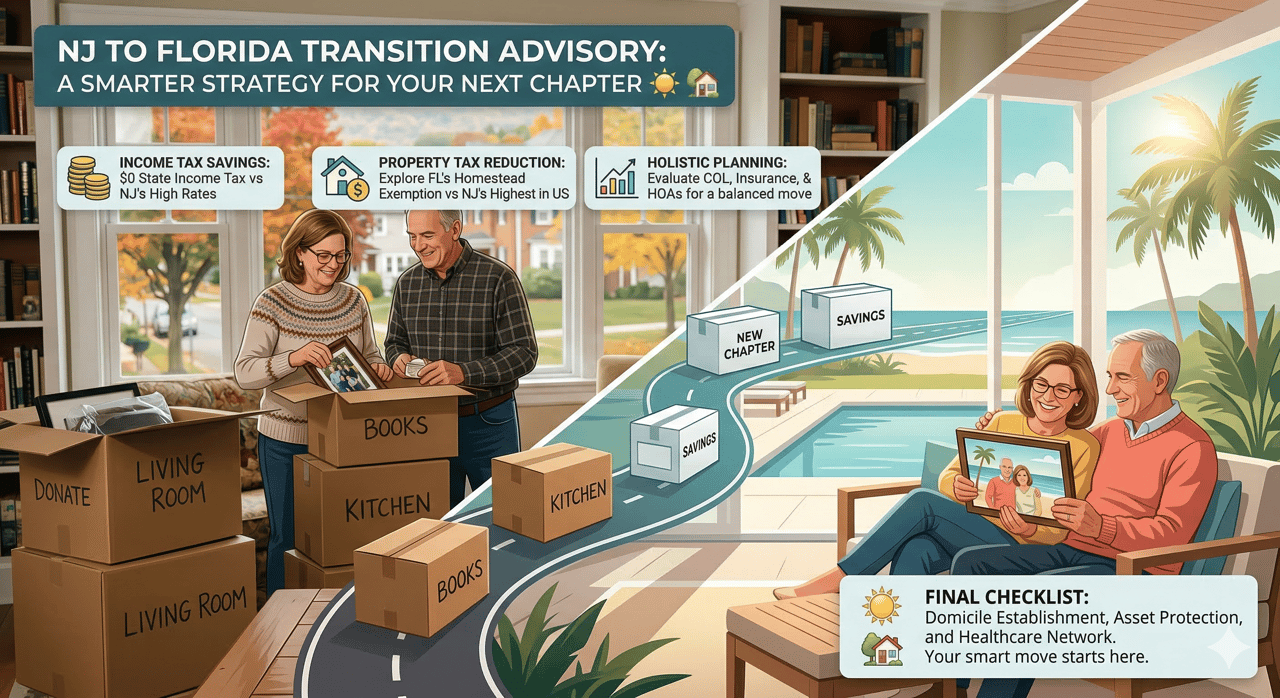
NJ to Florida Transition Advisory: A Smarter Strategy for Your Next Chapter ☀️🏡
For many long-time homeowners in Northern New Jersey, the idea of relocating to Florida is no longer just a retirement dream. It is becoming a carefully considered lifestyle decision. Whether the goal is downsizing, reducing long-term expenses, owning a second home, or creating a seasonal “snowbird” plan, the transition from New Jersey to Florida is complex.
It is not simply about selling one home and buying another. It is about protecting equity, managing timing, and designing the next phase of life with clarity and confidence.
Why the NJ to Florida Move Requires a Different Approach
Relocating across state lines introduces financial, logistical, and emotional considerations that do not exist in a local move. Many homeowners underestimate the sequencing decisions involved.
Questions quickly arise:
-
Should you sell your New Jersey home first, or secure a Florida property before listing?
-
How do taxes, insurance costs, and association fees compare between the two states?
-
What is the real financial impact of downsizing versus maintaining two properties?
-
How do you manage belongings accumulated over decades?
These decisions carry long-term consequences. Without a structured plan, homeowners risk unnecessary stress, missed opportunities, or outcomes that do not align with their lifestyle goals. A transition advisory approach focuses on thinking ahead rather than reacting under pressure.
The Role of a Transition Advisor
Traditional real estate representation often focuses on a single transaction. In contrast, transition advisory services are designed to guide homeowners through a broader life change. The emphasis is on strategy, sequencing, and long-term outcomes rather than simply listing a property or writing an offer.
An effective advisory process begins with clarity. Homeowners explore what they are truly trying to accomplish. For some, the goal is simplifying daily life. For others, it is unlocking home equity, reducing carrying costs, or moving closer to family. Some are planning phased moves that involve seasonal living arrangements.
By understanding these priorities first, a tailored plan can be created that aligns real estate decisions with financial and lifestyle objectives.
Understanding Equity and Timing
Many New Jersey homeowners considering Florida relocation have built significant equity over time. While this creates opportunity, it also introduces complexity. Selling too quickly may limit financial flexibility. Waiting too long could reduce negotiating leverage or create unnecessary carrying costs.
A thoughtful strategy evaluates multiple timing scenarios:
-
Selling before buying
-
Buying before selling
-
Overlapping ownership for a defined period
Each path has advantages and risks depending on market conditions, risk tolerance, and personal circumstances. The key is not choosing the “perfect” option in theory, but selecting the one that best supports long-term stability and peace of mind.
Lifestyle Math Versus Market Headlines
One of the most common mistakes homeowners make is focusing exclusively on market predictions. Interest rates, inventory levels, and seasonal trends are important, but they should not overshadow lifestyle considerations.
Downsizing is often framed as giving something up. In reality, many homeowners gain more than they lose. Reduced maintenance, simplified routines, and improved financial predictability can enhance quality of life. However, these benefits only materialize when decisions are made deliberately rather than reactively.
Transition advisory services help homeowners perform what can be described as “lifestyle math.” This involves evaluating not only the financial implications of a move, but also how the change will impact daily living, social connections, and future plans.
Emotional Factors That Influence Timing
Relocation decisions are rarely purely logical. Emotional attachment to a long-held home, fear of making the wrong choice, or uncertainty about leaving familiar communities can delay important moves.
Acknowledging these concerns is an essential part of the planning process. Structured guidance can help homeowners move forward at a comfortable pace while avoiding impulsive decisions driven by external pressure.
Clear communication, realistic expectations, and step-by-step planning can transform what feels overwhelming into a manageable transition.
Coordinating Two Markets
Another challenge of an interstate move is understanding the dynamics of two different real estate markets simultaneously. Pricing trends, buyer demand, and inventory conditions may vary significantly between New Jersey and Florida.
Coordinated planning helps ensure that the sale of one property and the purchase of another work together rather than against each other. This reduces the likelihood of temporary housing disruptions, financial strain, or rushed negotiations.
Homeowners who approach the process with a dual-market perspective are often better positioned to make confident decisions and maintain flexibility throughout the transition.
The Value of Experience
Guiding homeowners through complex life transitions requires more than theoretical knowledge. Experience working with downsizers, relocating families, investors, and multi-property owners provides valuable insight into potential challenges and solutions.
Over time, patterns emerge. Certain timing mistakes tend to repeat. Emotional blind spots can lead to regret if not addressed early. Financial assumptions may need to be recalibrated based on real-world outcomes rather than optimistic projections.
An advisory-focused approach uses this experience to help homeowners avoid common pitfalls and create smoother transitions.
A Structured Path Forward
A well-designed transition plan often follows four stages:
-
Clarity and Discovery – defining goals, timelines, and financial priorities
-
Strategic Planning – evaluating timing scenarios and market conditions
-
Execution Coordination – managing the sale, purchase, and logistics
-
Ongoing Guidance – adjusting the plan as circumstances evolve
This framework allows homeowners to move forward thoughtfully rather than feeling forced into rapid decisions.
Final Thoughts
Relocating from New Jersey to Florida is not simply about changing addresses. It is about reshaping lifestyle, financial structure, and long-term plans. With the right preparation and guidance, the transition can feel empowering rather than stressful.
Homeowners who invest time in strategic planning often discover greater flexibility, stronger negotiating positions, and increased confidence in their decisions. Instead of wondering whether they moved too soon or waited too long, they move forward knowing their choices were aligned with both market realities and personal priorities.
If a Florida move is even a distant possibility, beginning the conversation early can make a meaningful difference. The goal is not urgency. It is clarity.