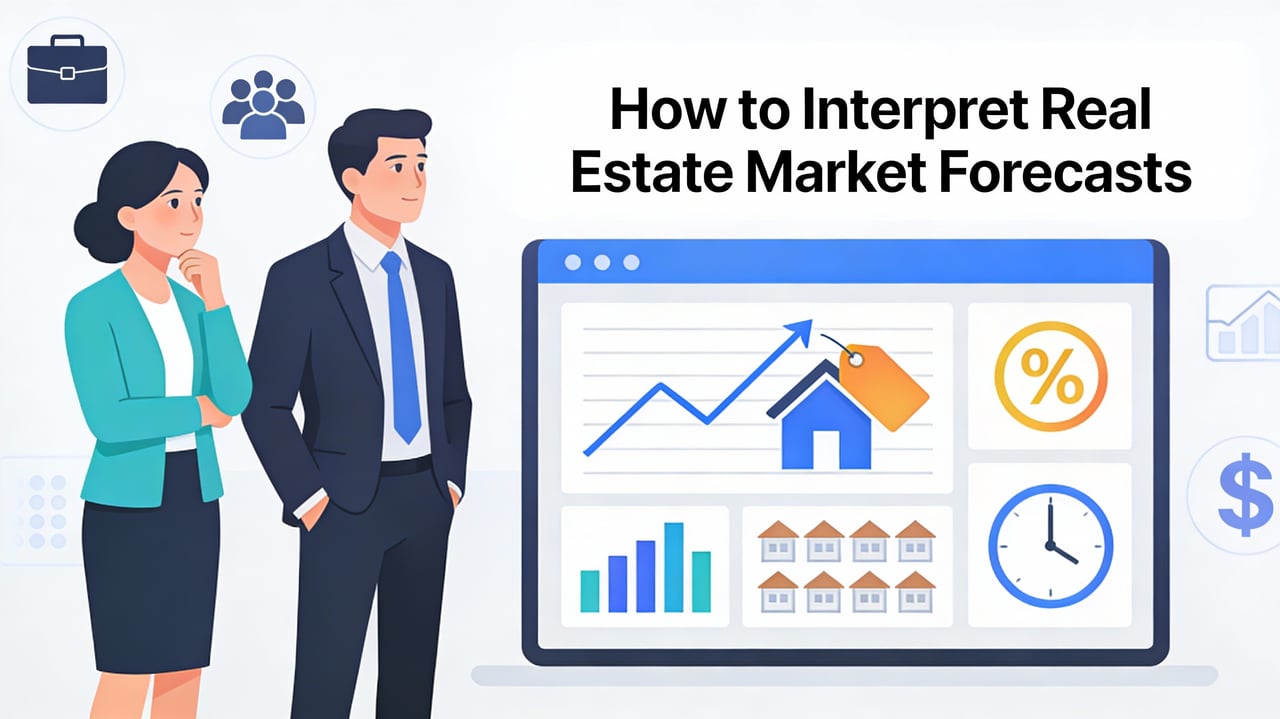
How to Interpret Real Estate Market Forecasts
If you follow real estate news, you’ve probably noticed one thing: the forecasts rarely agree.
One headline says prices are rising. Another predicts a slowdown. A third warns of a crash — again.
For homeowners and buyers trying to make real decisions, this can be confusing and unsettling. The truth is, market forecasts can be useful — but only if you know how to interpret them correctly.
Here’s how to separate helpful insight from noise and use real estate forecasts the right way.
What Real Estate Market Forecasts Really Are
Market forecasts are educated projections based on data such as:
Interest rates and lending trends
Housing supply and buyer demand
Employment and economic indicators
Historical pricing patterns
They are not guarantees. They’re broad directional tools meant to inform — not predict — individual outcomes.
Most importantly, national forecasts rarely reflect what’s happening in your specific town or neighborhood.
Why Forecasts Often Feel Confusing
Forecasts are usually designed for:
Economists
Investors
Media headlines
Not homeowners deciding whether to sell or buy.
That’s why you’ll often see conflicting predictions. Different models weigh data differently, and many forecasts are intentionally conservative or attention-grabbing.
Context matters more than the headline.
National Headlines vs. Local Reality
One of the biggest mistakes people make is assuming national forecasts apply directly to their local market.
In reality:
Real estate is hyper-local
Neighborhood supply can differ dramatically
Buyer demand varies by price point and property type
Timing matters more locally than nationally
What’s true for the country may not be true for Bergen County — or even the next town over.
What Forecasts Can Help You Understand
Used correctly, forecasts can help you:
Understand the general direction of interest rates
See whether supply is tightening or loosening
Identify periods of increased buyer or seller leverage
Prepare emotionally for market shifts
They are best used as a backdrop — not a decision-maker.
What Forecasts Can’t Tell You
Forecasts cannot:
Tell you the best price for your specific home
Predict buyer behavior on your block
Account for property condition or presentation
Replace a local market analysis
Your home doesn’t sell in a forecast — it sells in a neighborhood.
How Homeowners Should Use Market Forecasts
If you’re a homeowner considering selling, forecasts should be one input — not the driver.
Smart questions to ask:
How does this forecast compare to current local data?
What’s happening with inventory in my price range?
Are buyers still active where I live?
How does timing align with my personal goals?
Life often dictates timing more than the market does.
How Buyers Should Read Forecasts
Buyers often worry about “buying at the wrong time.”
Forecasts can help buyers:
Understand rate trends
Prepare for competition or negotiation opportunities
Set realistic expectations
But waiting for a “perfect” forecast often means missing the right home.
The Role of a Local Expert
The most valuable filter for any market forecast is a knowledgeable local advisor.
A good agent helps you:
Translate national data into local relevance
Compare forecasts to real-time market behavior
Adjust strategy without reacting emotionally
Make decisions based on facts, not fear
This is where clarity replaces noise.
Final Thought
Real estate market forecasts are tools — not truths.
When understood properly, they can inform smarter decisions. When misunderstood, they create unnecessary anxiety.
The best decisions are made when forecasts are balanced with local data, personal goals, and thoughtful guidance.
About Scott Selleck
Scott Selleck is a Broker/Sales Associate licensed since 1993 helping homeowners and buyers navigate changing real estate markets with confidence.
As leader of The Selleck Group at Keller Williams City Views Realty, Scott specializes in high-equity strategy, downsizing, and NJ → Florida transitions — guiding clients through market uncertainty with clarity and care.
I guide NJ homeowners into their next chapter — one smart move at a time.
High-touch service. Data-driven decisions. Zero surprises.
Scott Selleck | The Selleck Group | Keller Williams City Views Realty
2200 Fletcher Avenue, Suite 502, Fort Lee, NJ 07024
Office: 201-592-8900 | Cell: 201-970-3960
www.SelleckSellsNJ.com | [email protected]